Pages

Showing posts sorted by relevance for query inflation expectations. Sort by date Show all posts

Tuesday, August 3, 2010

Inflation Expectations Are Not Stable!

Many observers, including myself, have been puzzled by the Fed's lack of urgency in recent months over the apparent slowing down of aggregate demand.  The one thing monetary policy is capable of doing is stabilizing total current dollar spending, but it isn't and this inaction effectively amounts to a tightening of monetary policy.  There have been many reasons given for this seeming complacency by the Fed: internal divisions over policy, fear of political backlash, opportunistic disinflation, fear of awakening bond vigilettentes, and sheer exhaustion.  Another potential reason is that the Fed simply doesn't see this aggregate demand slowdown in the data.  I actually considered this possibility some time ago but never put too much weight on it since this is the Federal Reserve after all.  It has far more resources than I do and  surely sees what I see in the data. However, after Fed Chairman Ben Bernanke's speech yesterday I am beginning to wonder if the Fed is actually missing something in the data.  In particular, I was stunned to read this sentence in the speech:
Meanwhile, measures of expected inflation generally have remained stable.
Uhm, unless I have been living in parallel universe and just got phased into a different one this  statement is completely wrong.  Inflation expectations, as I show below, have been persistently declining  since  the start of  2010.  Not only that, but Bernanke's claim that inflation expectations are stable has huge policy implications.  It is widely understood that expectations of future inflation are a key determinant of current aggregate demand.  If expectations of inflation are stable as Bernanke claims then aggregate demand growth should also be relatively stable.  On the other hand, if inflation expectations are falling and have been doing so for some time as I claim then it is likely that current aggregate demand growth also has been falling.*  

If Bernanke really believes inflation expectations are stable then one must give him credit for implementing monetary policy in a manner consistent with that understanding.  However, I simply cannot understand how he or anyone else at the Fed could hold such a view.  The best indicators of inflation expectations have been screaming red alert for some time now.  How the Fed could have missed this red alert is unfathomable to me, but on the off chance that they have and are reading this post I ask that they please take note of the following set of figures.

The first figure shows the term structure of expected inflation over the first half of 2010.  The plotted curves in the figure show the average expected inflation rate at various yearly horizons for the first six months of 2010.  The data comes from the Cleveland Fed. This figure makes clear that inflation expectations have been trending down across all horizons since the start of the year. Note that the 1-year horizon has seen inflation expectations drop by  about 100 basis points. (Click on figure to enlarge)


Now to put this figure into perspective let's look at the term structure of inflation expectations the last time expected inflation fell rapidly and caused aggregate demand to tank.  Yes, that would be the late 2008, early 2009 period.  Here is the figure for this time.  Notice any similarities? (Click on figure to enlarge.)


Here too we see a decline across all horizons with the 1-year having the sharpest decline.  Now current inflation expectations have not fallen as much as these above but they are persistently falling.  And we  know from the late 2008, early 2009 experience what happens to aggregate demand when inflation expectations are allowed to continue to fall: you get the greatest decline in nominal spending since the Great Depression.  

Now the dire picture painted by the Cleveland Fed data is wholly corroborated by the inflation expectations implied by the the difference between the nominal interest rates on regular treasury securities and the real interest rates on treasury inflation protected securities (TIPS).  This measure of inflation expectations is graphed below using daily data on 5-year treasuries for the period January 4, 2010 - July 29, 2010: (Click on figure to enlarge.)


Here again there is a clear downward trend. Inflation expectations are falling and there is currently no end in sight.  Given all of this evidence, how can Ben Bernanke assert that inflationary expectations are stable?  I am truly bewildered by that claim. I hope Fed officials who have read this far are also bewildered and are now reconsidering their views.  Let me be very clear what all of this implies: by failing to stabilize inflation expectations the Fed is effectively tightening monetary policy at a most inopportune time. I hope this is not how the Fed wants to be remembered. 

Wednesday, November 17, 2010

Rising Yields Is A Good Sign

A key objective of QE2 is to raise nominal spending.  Given sticky prices and excess economic capacity, this increase in nominal spending would boost the real economy.  Now the way QE2 can raise nominal spending is by raising inflation expectations.  Higher inflation expectations creates the incentive for banks, firms, and households sitting on money to start spending it.  In fact, the key problem facing the U.S. economy right now is an excess money demand problem.  While it is true that rising inflation expectations may temporarily lower real interest rates too and thus stimulate interest sensitive spending, this effect is of second-order importance and is only temporary.  The real and lasting reason rising inflation expectations are important is that they address the excess money demand problem. 

Many observers miss this important point and its implications for interest rates. Imagine QE2 is successful in breaking the excess money demand problem and aggregate spending increases. The real economy starts recovering too.  These developments would imply the following: (1) expected inflation must have picked up at some point and (2) real interest rates would start rising in response to the recovery of the real economy.  In other words, one would expect to start seeing nominal interest rates--the sum of the real interest rate and expected inflation--to start  increasing if QE2 is successful.  QE2, then, would not only be a boon to the  real economy, but also to savers and folks living on fixed income given the rise in real interest rates. 

Now I think QE2 should have been implemented differently--the Fed should  have announced an explicit rules-based nominal target and forcefully commit to maintaining it--and I am concerned that political pressure may prevent it from being effective. Still, if it does work in its current form then rising yields would be one sign of success.  Though it is probably too soon judge its effectiveness based on this criteria, here is a look at the expected inflation and the real yield on 10-treasury securities.  The figure covers the last month and half, the time period when Fed officials first started talking up QE2 up through the present. (Click on figure to enlarge.)

Source: FRED Data

The blue line in the figure reveals that inflation expectations started increasing in October with the onset of the Fed's full court PR press on QE2.  Inflation expectations had been downward trending all year until this point.  QE2 reversed that trend. So on this point, QE2 appears to be working.  (Inflation expectations, however, have not continued climbing since QE2 was made official and that is a little troubling.) The red line indicates that the real interest rate has seen a sudden spike in the past week.  So on this point, QE2 appears to be working too.  Again, I reach these conclusions with some trepidation since it is so early into the QE2 program. 

I raise these points because some observers like the Wall Street Journal and Barrons are looking at the same data and making statements like the "Bond Market Defies the Fed" and "Bond Vigilantes Rise Again." They claim that the bond market is pushing back against the Fed and beating it.  I say not so fast guys,  the bond market may actually be following the QE2 according to plan. Let's wait and see how this plays out, but along the way don't forget that rising yields is actually a good sign.

Monday, February 28, 2011

Yes, Monetary Policy Does Matter

Christina Romer has an Op-Ed on U.S. monetary policy that raises several important points.  First, she does a good job explaining that monetary policy can still pack a punch even when short-term interest rates are close to zero.  She reminds us that unconventional monetary policy during the Great Depression--the original QE program--did wonders for the economy in a far worse economic environment than today. If it did such an incredible job back then, why couldn't it do the same today?   This is a point I made late last year to Paul Krugman.  It should encourage folks like him and Mark Thoma to be more optimistic about what monetary policy can do to shore up the  recovery.  

Second, Romer explains why U.S. monetary policy is not doing more given its untapped potential.  She attributes this failure to to a polarizing division among  two types of policymakers: empiricist and theorist.  Here is how she describes them:
Empiricists, as the name suggests, put most weight on the evidence. Empirical analysis shows that the main determinants of inflation are past inflation and unemployment. Inflation rises when unemployment is below normal and falls when it is above normal.

Though there is much debate about what level of unemployment is now normal, virtually no one doubts that at 9 percent, unemployment is well above it. With core inflation running at less than 1 percent, empiricists are therefore relatively unconcerned about inflation in the current environment.

Theorists, on the other hand, emphasize economic models that assume people are highly rational in forming expectations of future inflation. In these models, Fed actions that call its commitment to low inflation into question can cause inflation expectations to spike, leading to actual increases in prices and wages.

For theorists, any rise in an indicator of expected or future inflation, like the recent boom in commodity prices, suggests that the Fed’s credibility is at risk. They fear that general inflation could re-emerge quickly, despite high unemployment
I don't like this division. It creates the impression that all empiricists don't use foward-looking theory to asses their reading of the data.  Far from it.  Take, for example, the core inflation measurement mentioned above.  The only reason policymakers look to this is because it provides an indicator of where trend inflation is headed.  Also, many empiricists look to explicit forward-looking market measures found in various assets prices.  The most obvious one is the expected inflation series that comes from the spread between  yields on nominal and real treasury securities.  Empiricists are looking to these forward looking measures and see no  runaway inflation on the horizon.  For example, below is the expected inflation term structure--the expected inflation rate across various forecast horizons--from the Cleveland Fed.  This data is a cleaned-up version of the expected inflation series implied by treasury securities.


This figure shows that since QE2 1-year inflation expectations have gone from 0.90% to 1.80% while 10-year inflation expectations have gone from 1.55% to 1.82%.  These numbers are low relative to the implicit 2.00 to 2.50% inflation target of the Fed.  Empiricists care about these indicators because they understand the importance of keeping them anchored.  So far, though, there is no sign of them becoming unanchored. If any thing, the theoretically-driven empiricists see a reanchoring of inflation expectations that is pulling them down and preventing a more robust recovery. 

So what is the solution?  Christina Romer suggests a price level target.  It would be a vast improvement over QE2 in terms of efficacy and it would add more long-run certainty.  However, for the reasons outlined here, an even better alternative would be a nominal GDP level target. 

Update: Marcus Nunes and Steven Williamson also respond to Christina Romer's piece.

Friday, August 27, 2010

Bernanke's Speech: A Big Tease

Ben Bernanke delivered a much anticipated speech today at the Jackson Hole Economic Symposium.  Many observers, myself included, were wondering if he would advocate a more aggressive role for monetary policy given the signs of weakening in the U.S. economy.  Instead, what he delivered was a big tease: he acknowledges three points made by advocates of more monetary easing, but then either ignores the implications of these points or argues against them.

Let's look at the three points he acknowledges in turn.  First, he concedes that the low interest rates can reflect a weak economy rather than being a sign of loose monetary policy.  Second, he grants that the Fed can be effectively tightening monetary policy simply by being passive.  He makes these two big concessions in his discussion of why the FOMC decided to stabilize the Fed's balance sheet (my bold):
[A]llowing the Federal Reserve's balance sheet to shrink in this way at a time when the outlook had weakened somewhat was inconsistent with the Committee's intention to provide the monetary accommodation necessary to support the recovery. Moreover, a bad dynamic could come into at play: Any further weakening of the economy that resulted in lower longer-term interest rates and a still-faster pace of mortgage refinancing would likely lead in turn to an even more-rapid runoff of MBS from the Fed's balance sheet. Thus, a weakening of the economy might act indirectly to increase the pace of passive policy tightening--a perverse outcome.
Consider the implications of these points.  First, if lower interest rates reflect economic weakness--though he mentions long-term interest rates recall they are the expectation of a bunch of short-term interest rates plus some term premium--then one implication is that the low federal funds rate may not be so accommodative after all. Given the state of the economy, maybe the 0%-0.25% range for the federal funds rate is not low enough.  Now the federal funds rate cannot go negative (and this is one of the problems with using an interest rate target), but if it could the implication here is that it may need to go deep into negative territory in order to be at the appropriate level.  Folks like Andy Harless and Glenn Rudebusch have made this very point. So what does Bernanke think? Does he run with his own argument to its logical conclusion?   The answer is no. Elsewhere in the speech he claims that "monetary policy remains very accommodative" and that the "Fed has also taken extraordinary measures to ease monetary and financial conditions. Notably,... the FOMC has held its target for the federal funds rate in a range of 0 to 25 basis points..." In short, Bernanke thinks the low federal funds rate is sufficiently accommodative, even after acknowledging that low interest rates can reflect weak economic conditions rather than loose monetary policy.

Now consider his second concession: the Fed can effectively be tightening monetary policy just by being passive.  He acknowledges this point in the context of stabilizing the Fed's balance sheet.  This is an important insight, but what about the other ways the Fed can passively tighten monetary policy? Currently, the Fed is failing to stabilize the NGDP or aggregate demand forecast. By allowing this to happen the Fed is effectively tightening monetary policy.  Why is he not concerned here too about such passive tightening of monetary policy?

Bernanke's third concession is an important one too. In his discussion of what the Fed can do if more action is required, he alludes to the idea of price level targeting. Now this option is not as good as NGDP level targeting, but it would be vast improvement over what is going on. Here is what he said:
A rather different type of policy option, which has been proposed by a number of economists, would have the Committee increase its medium-term inflation goals above levels consistent with price stability... in such a situation, higher inflation for a time, by compensating for the prior period of deflation, could help return the price level to what was expected by people who signed long-term contracts, such as debt contracts, before the deflation began.
He is absolutely right that a price level target would mean higher than normal inflation currently to get the economy back to its previous price level path.  If such a price level target were formally announced, it would go a long ways in (1) creating more economic certainty  and (2) helping household balance sheets repair themselves. So is Bernanke on board? Unfortunately, for two reasons the answer is no. First, he sees no support for such a policy in the FOMC .  And, apparently, this is one battle he does not want to fight at the Fed.  Second, and more troubling, he does not think it is needed and believes it could even be problematic:
However, such a strategy is inappropriate for the United States in current circumstances. Inflation expectations appear reasonably well-anchored, and both inflation expectations and actual inflation remain within a range consistent with price stability. In this context, raising the inflation objective would likely entail much greater costs than benefits. Inflation would be higher and probably more volatile under such a policy, undermining confidence and the ability of firms and households to make longer-term plans, while squandering the Fed's hard-won inflation credibility. Inflation expectations would also likely become significantly less stable, and risk premiums in asset markets--including inflation risk premiums--would rise. The combination of increased uncertainty for households and businesses, higher risk premiums in financial markets, and the potential for destabilizing movements in commodity and currency markets would likely overwhelm any benefits arising from this strategy
 This is perplexing on so many levels. First, an explicit price level target would not destroy long-run inflation expectations.  Yes, there may be an inflation catch up period, but over the long-run the inflation rate would be governed by the inflation rate implied by the price level target.  (Of course, an even better solution would be targeting a NGDP level, but I digress.) Second, for the 100100 time, inflation expectations are not stable or well anchored.  The have been falling all year across all horizons as can be seen with the Clevend Fed data .  This sustained decline can also be seen below on a daily basis for the five-year horizon:


How can there be any question about falling inflation expectations?  (For those concerned that the liquidity premium is distorting the implied expected inflation rate from the Treasury market note the following.  First, the Cleveland Fed data corrects for this potential distortion.  Second, even in the case of the chart above a heightened liquidity premium only reinforces the likelihood of growing deflationary pressures. This is because a heightened liquidity premium implies a heightened demand for highly liquid assets like treasuries and money. In turn, this implies less spending and greater deflationary pressures.) Third, if there is anything driving increased uncertainty it is a weakening economy. And by failing to stabilize  inflation expectations, the Fed is allowing economic uncertainty to grow.  Bernanke seems hung up on a potential source of economic uncertainty instead of looking to an actual source of economic uncertainty. 

What a big tease.

Monday, September 27, 2010

More Inflation Yes, Inflation Targeting No!

Scott Sumner has two new posts up that speaks to something that has been bugging me lately: the increasing popularity of an explicit inflation target for the Fed.   Many bloggers, including myself, have been calling for the Fed to create more inflation or at least stabilize inflation expectations.   I have been particularly vocal on the latter point.  Others have been  more forceful in their call for an explicit inflation target as a means to increase the inflation rate.  All along, my reason for arguing for the Fed to stabilize inflation expectations is that doing so would indicate the Fed is stabilizing expectations of future  aggregate demand (given that productivity does not appear to be contributing to drop in inflation expectations).  Such actions, in turn, would also serve to stabilize current aggregate demand as  well.  

Now, I have never been enthusiastic about stabilizing inflation as an end in itself.  The reason being is straightforward: inflation is a symptom, not an underlying cause.  More generally,  the percentage change in the price level could be the result of shocks to  aggregate demand (AD), aggregate supply (AS), or both.  Currently, it seems clear that the drop in inflation expectations and the drop in core inflation are reflecting faltering aggregate demand.  Thus, it makes sense to talk about the need to arrest these drops.  However, it need not always be the case--low inflation could also be the symptom of a positive AS shock (e.g. productivity boom).   Imagine, for example, aliens land and give us new technology that makes our computers faster, gives us clean energy, and allows us to travel to  distant galaxies.  Such an alien encounter would create mother of all productivity booms.  Among other things, this productivity boom would imply a higher neutral interest rate, lower inflation rate, and robust AD growth (given  the increase in expected future income).  In such a case a rigid inflation target of say 4%, as some have proposed, would not make  sense here.  Most likely it would be too high an inflation rate to keep AD stable.   

Another way of saying all of this is that monetary policy should focus only on that over which it has meaningful control:  total current dollar spending or AD.  It should ignore AS shocks, both the good and the bad, because all it can do by responding to such shocks is to make matters worse  as alluded to above.   Focusing too narrowly on an inflation target--which assumes every shock is an AD one--can cause a central bank to make this very mistake.  I made this case before in  more detail in this post which got some play time in the economics blogosphere (e.g. Mark Thoma reposted it here).  My hope was that this post would help folks see that the stabilization of AD rather than inflation targeting should be the key  objective of monetary policy. 

So what kind of monetary policy would serve to consistently stabilize AD?  The answer is one that directly targets a stable growth path for AD. This could be a NGDP target or a final sales of domestic output target or any measure that directly aims to stabilize the growth of total current dollar spending.  Scott Sumner outlines its advantages in a recent post, but let me add a few thoughts.  First, an AD target is easy to implement.  All it requires is a measure of the current dollar value of the economy.  It does not require debates over the proper inflation measure, inflation target, output gap measure, and coefficient weights that plagued inflation targeting and the Taylor Rule.  Second, it can easily be made into a forward-looking rule by having the Fed targeting the market's forecast of AD.  This would require some innovations such as  NGDP futures market, but it is within the realm of possibilities as shown by Scott Sumner.  Finally, it could be easily communicated to and understood by the public by labeling it along the line of a "total cash spending target." 

Let me end by noting some of the famous observers who have called in the past for some form of AD targeting: Bennet McCallum, Greg Mankiw, Robert Hall, Menzie Chinn, Jeffrey Frankel, Martin Wolf, Samuel Brittan, and Frederick Hayek. I like this crowd, how about you?

Update: Karl Smith replies to Scott Sumner and me on this issue.  One point Karl brings up is the possibility that a NGDP target could increase macroeconomic instability.  Bennett McCallum addressed this issue a while back and showed that this need not be the case if there is forward looking behavior.  More recently, Kaushik Mitra showed that even with adaptive expectation-type behavior NGDP targeting can work well. 

Friday, October 5, 2012

More NGDP Targeting Concerns: Gavyn Davies Edition

Gavyn Davies has a new column where he responds to Michael Woodford's call for a NGDP level target.  Davies is always a good read, but this time he raises some concerns about NGDP level targeting that are unwarranted.  He claims  that the Fed may be uncomfortable with a NGDP level target because it might unmoor inflation expectations, it might be seen as time-inconsistent with the Fed's long-run objectives, and finally it may be too late to return NGDP to its pre-crisis trend.  While understandable, the first two concerns are without merit under NGDP level targeting.  This approach to monetary policy actually anchors long-run inflation expectations and provides a credible way to commit.  The last concern has more merit, but even here it is not a clear-cut case. Let's look at each of these concerns in turn.

Thursday, December 17, 2009

Monetary Policy Quote of the Day

Scott Sumner on the efficacy of monetary policy even when the policy interest rate hit zero:
Zero rates don’t really make monetary policy more difficult, they make interest rate-oriented monetary policy more difficult... Permanent QE is just as effective as ever. Exchange rate depreciation is just as effective as ever, inflation targeting is just as effective as ever, NGDP targeting is just as effective as ever, commodity price targeting is just as effective as ever.
The strangest thing is that Ben Bernanke agrees with Sumner on this point. Just today we learn of his written reply to a Brad DeLong question on why the Fed has not adopted an explicit 3% inflation target (something that would have done wonders to prevent the great nominal spending crash of late 2008, early 2009):
...The Federal Reserve has not followed the suggestion of some that it pursue a monetary policy strategy aimed at pushing up longer-run inflation expectations. In theory, such an approach could reduce real interest rates and so stimulate spending and output. However, that theoretical argument ignores the risk that such a policy could cause the public to lose confidence in the central bank’s willingness to resist further upward shifts in inflation, and so undermine the effectiveness of monetary policy going forward. The anchoring of inflation expectations is a hard-won success that has been achieved over the course of three decades, and this stability cannot be taken for granted. Therefore, the Federal Reserve’s policy actions as well as its communications have been aimed at keeping inflation expectations firmly anchored. [Emphasis added]
So Bernanke agrees with Sumner in principle but is afraid of inflation expectations becoming unmoored. A look at the average 10-year inflation forecast from the Survey of Professional Forecasters says Bernanke should not be worried about inflation expectations. They have been anchored relatively well since 1997 around 2.5 percent:

Too bad Paul Krugman was not beating his influential drum with a message of inflation targeting--or in my dream world nominal income targeting--over the past year or so. Maybe others would have joined in and forced Bernanke and the Fed to think more about this option. Krugman admitted recently it would have been the first-best economic solution to the current crisis, but avoided doing so because he thought it would be a second-best political solution. (He thought expansionary fiscal policy would be more politically feasible.) Even if Krugman and other observers have been pushing the unconventional monetary policy message more forcefully over the past year, it is still not clear the Fed would have responded. David Wessel in his new book reports that Bernanke came into the Fed wanting to target inflation. He faced, however, strong opposition and (unlike his predecessor) wanted to be a consensus builder at the Fed. He did not want to force his hand on the FOMC.

Update: Scott Sumner, Brad DeLong, Free Exchange, and Will Wilkinson comment on Bernanke's response.

Tuesday, November 16, 2010

About that Runaway Inflation The Fed is Creating

I am having a hard time finding it when I look to inflation expectations.  Here is the average annual expected inflation rate over the next five years implied the spread between nominal and real yields on treasury securities:
(Click on figure to enlarge.)

Note that most of the pick up in expected inflation occurs during October when Fed official were talking up QE2. Since then inflation expectations have not exploded but drifted around where they had been, around 1.6%.  It is also worth noting in this figure that inflation expectations were steadily heading down for most of the year.  QE2 has reversed that, but has yet to push inflation expectations up to the 2.0% value the Fed would like to see it. Contrary to the rhetoric, then, QE2 is not the great inflation creating machine some claim it is. And just to be clear, it is not inflation per se that the Fed or supporters of QE2 ultimately want.  What they really want is to increase aggregate spending.  Raising inflation expectations would do that as I explain here.  If only the Fed would adopt a nominal GDP level target many of these problems would dissappear. 

Wednesday, August 18, 2010

It's Happening: Aggregate Demand Forecasts Are Falling

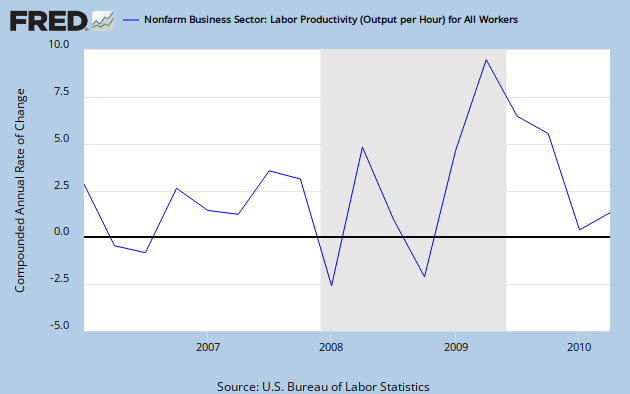
For some time I have been making the case that the sustained decline in inflation expectations is indicating the market is expecting aggregate demand to decline going forward.  Given the Fed's failure to meaningfully respond to these forecasted declines, I have also claimed these developments effectively amount to a tightening of monetary policy.  This interpretation, however, can be challenged because inflation is a symptom of changes in aggregate supply and aggregate demand.  Thus, inflation expectations could be going down because productivity growth has been robust rather than from a decline in total current dollar spending. My view that it has been an expected weakening of aggregate demand driving the  declines in inflation forecasts has been based more on circumstantial evidence than any direct measures of aggregate supply or aggregate demand.  Recent data releases, however, now firmly support my view. First, nonfarm business labor productivity declined at annualized rate of 0.9% in the 2010:Q2.  No positive aggregate supply shocks here. Second, the just released Survey of Professional Forecasters shows a marked drop in the forecasted growth rate of aggregate demand over the next year as measured by nominal GDP (NGDP).  This drop is graphed below and shows the NGDP forecast made in May, 2010 and the NGDP forecast made in August, 2010. (Click on the figure to enlarge.)

Here, the forecast for 2010:Q3 takes an alarming drop, going from a forecast of about 4.50% growth in May to a forecast of 3.24% in August.  The Fed, therefore, has allowed NGDP forecasts to fall by 1.26% over these two quarters.  Does that make any sense in the current economic environment?   Does the Fed not realize that by passively allowing such developments it is effectively tightening monetary policy?  I wish I could have a one-on-one with some of the Fed officials and ask them to explain to me their indifference to these developments. 

So it is happening: aggregate demand forecasts are falling.  And unless the Fed arrests this development it could get worse. Hopefully the FOMC's decision last week to stabilize the Fed's balance sheet is an indication that it is begining to take notice of these warning signs.

PS.  This crisis has really driven home to me the need for a NGDP futures market.  Why does no such  market exist?  

PPS. The above discussion highlights the importance of being careful in interpreting inflation.  In general, I don't think we should spend so much time looking at inflation but rather focus on the underlying causes of inflation: shocks to aggregate demand and aggregate supply.  Monetary policy can only stabilize the former and should avoid responding to the latter.  A pure inflation target, however, ignores this distinction and has the potential to increase macroeconomic instability as shown here.  That is why I favor a NGDP target over an inflation target.

PPPS.  The FOMC statement from last week said the following:
Measures of underlying inflation have trended lower in recent quarters and with... longer-term inflation expectations stable, inflation is likely to be subdued for some time. 
How can the FOMC claim inflation expectations are stable? Bernanke made the same puzzling claim in his last speech which prompted me to do my last post. What inflation forecast is the FOMC using? One would think that the conservative bond market with billions of dollars on the line would be the best place to get an inflation forecast.

Update: I should have mentioned that the forecasted values above are the averages of all the individual economic forecasts provided by the economic forecasters to the survey.

Monday, December 14, 2015

The Fed Gets What It Wants: A 1%-2% Inflation Target Corridor

So it is finally time for lift off. The Fed is poised to raise short-term interest rates over the next few days after seven long years of ZIRP. Exciting as this development may be, it is important to keep in mind that the guiding principle behind the Fed's decisions during this time has not suddenly changed. This principle says that no matter what happens--whether it be ZIRP, QE, forward guidance, the changing winds of fiscal policy, or the normalization of monetary policy--the Fed must always act in a manner to keep core PCE inflation within a 1-2 percent inflation corridor. 

Yes, even though the Fed has an official 2 percent inflation target revealed preferences indicate the real force shaping Fed policy has been a 1-2 percent inflation target corridor over the past seven years. Once you understand this point all other Fed mysteries begin to clear up. For example, why did the Fed sterilize its lending to banks between December 2007 and October 2008? Or, why did it introduce IOR just as the markets were imploding or make the asset purchases under QE temporary? The answer is that it did not want rapid growth in nominal spending--even though it was sorely needed--for fear of pushing inflation too high.  The Fed, in other words, was willing to sacrifice the economy at the altar of the inflation target corridor. This framework is likely to continue going forward.

But don't take my word for it. Let's look to the data and let the FOMC's revealed preferences speak for themselves. 

Consider first the central tendency consensus forecasts of core PCE inflation by FOMC members.  The figures below show these forecasts for the current year, one-year ahead, and two-years ahead horizons. A clear pattern emerges from these figures as you expand the forecast horizon: 2 percent becomes a upper bound. FOMC officials, therefore, have been consistently looking at an upper bound of 2 percent for core PCE inflation. If we add to this fact that the FOMC has meaningful influence on inflation several years out, then these revealed preference are saying Fed officials actually want and expect to get an inflation upper bound of 2 percent. This inflation corridor is a choice.


Now consider the actual performance of core PCE inflation since the crisis started. This is where the 1 percent lower bound on the corridor becomes evident. The Fed seems ready to pull the monetary trigger if core inflation drifts too close to this lower bound. Currently, core inflation has stabilized around 1.3 percent but should it start falling again I would not be surprised to see the Fed getting trigger happy once again.


These revealed preferences of the Fed have begun to affect the public's long-term inflation expectations.The figure below shows the annual average inflation forecast over the next 10 years from the Survey of Professional Forecasters. I would not call these forecasts unanchored, but they are gradually drifting down. In the past we worried about expectations becoming unanchored as inflation expectations drifted upward. Now it seems they are drifting in the other direction, though presumably anchored by a lower bound.


The low inflation environment of the past few years seems entirely in line with the revealed preferences of FOMC officials. There is nothing mysterious about it. Fed officials are getting what they want. Unfortunately, aiming for a inflation corridor of 1-2 percent does guarantee macroeconomic stability. This inflation target range could be either be too tight or too easy depending on the state of the economy. It would be far better for the Fed to simply stabilize the growth path of aggregate spending. Until then, expect the Fed's decisions to be guided by the inflation target corridor. 

P.S. See Russ Robert's interview of George Selgin on EconTalk for an interesting discussion where some of the Fed's mysterious actions over the past seven years are discussed.

Update: Janet Yellen, made this point in the press conference following the December 2014 FOMC meeting (my bold):
But it’s important to point out that the Committee is not anticipating an overshoot of its 2 percent inflation objective (p.13).

Friday, September 30, 2011

What Is Wrong With this Statement?

Following a speech on Wednesday, Fed Chairman Ben Bernanke had this to say in a Q&A:
"If inflation itself falls too low or inflation expectations fall too low, that would be something we'd have to respond to because we don't want deflation[.]"
At first glance this statement seems reasonable, but upon further reflection there is something troubling about it.  It is the monetary policy equivalent of locking the barn door after the horse is already out.  Bernanke is saying here the Fed will respond after inflation falls too low.  Why not lock the barn door up front by explicitly targeting inflation expectations so that the public's expectations about future spending and price growth are anchored and not likely fall in the first place?   If this were the way monetary policy were conducted the Fed would be a little more concerned right now about the now 6-month downward trend in inflation expectations.  

If there is one lesson the Fed should have learned from this crisis is that it needs to take a more forward-looking approach to monetary policy.  Nowhere is this more clearly seen than in the Fed's September, 2008 FOMC meeting where it decided against further monetary easing because of concerns about rising inflation.  Had the Fed been giving more weight to the forward-looking inflation expectations coming from TIPs, it would have noticed that the outlook had been deteriorating since mid-2008.  Instead, the Fed was looking in its rear view mirror and saw the realized inflation rates of the past few months that had temporarily gone up because of supply shocks.  

Of course, in my ideal world the Fed would go one better and target nominal GDP futures contracts.  They don't exist now, but I am hoping that one they do and the Fed explicitly targets them.  Not only would such a policy better anchor nominal spending expectations, it would also make the Fed a whole lot more transparent and thus accountable to the public.

Monday, January 16, 2012

James Pethokoukis on NGDP Targeting

James Pethokoukis has a new article in Commentary that examines nominal GDP (NGDP) targeting and its potential to spark a recovery.  The piece starts out fine, but then gets gets confused because it fails to distinguish between a NGDP growth rate target and a NGDP level target.  A NGDP growth rate target, like an inflation target, lets bygones be bygones.  A NGDP level target, on the other hand, corrects for past mistakes.  Under a NGDP level target a central bank would commit to reigning in aggregate nominal spending if it overshot and  vice versa.  Such a rule would therefore actually anchor long-run inflation expectations while allowing for aggressive catch-up growth (or contraction) in aggregate nominal spending so that NGDP returned to its trend path.  The following figure illustrates these important differences:


Note that with a NGDP growth rate target (the blue line) NGDP can be growing on target and yet the big collapse in aggregate demand that precedes it is never corrected.  With those points made, let's turn to Pethokoukis' piece:
And there’s the rub. The idea of nominal GDP-targeting would threaten the Fed’s hard-fought credibility as an inflation-killer and raise expectations of future inflation simply to jimmy the unemployment rate a point or so lower than it would be five years from now. 
No. There might be higher inflation in the short-run, but over the long-run a NGDP level target would anchor  (see the red line) nominal expectations.  But even then, some higher inflation over the short run is actually justified.  For it would restore nominal incomes to where they were expected to be when debtors and creditors agreed to nominal contracts and similarly it would return debt burdens to the path expected when the contracts were signed. 

And then there is the Glenn Hubbard adding to the confusion:
 [M]arkets [may] begin to worry that the Fed won’t be able to unwind its positions in a timely manner to prevent an uncontrolled inflation surge...That concern is well justified, according to R. Glenn Hubbard, dean of Columbia’s business school and potential Fed chairman if a Republican wins the White House in 2012. As he told me recently: “In the near term, it’s hard for me to imagine that [NGDP-targeting] would work much differently than what the Fed is currently doing, which isn’t exactly a booming success. And then in the longer term, I would worry about inflationary expectations becoming unhinged….
No.  Hubbard is thinking of a NGDP growth rate target (the blue line.) Advocates of NGDP targeting are thinking of a level target (the red line) which implies more aggressive but systematic monetary stimulus. And no, the inflation expectations would not get unhinged because this is a level target.  As we learned from FDR's experience with level targeting in 1933-1936, such an approach can do wonders for the real economy and still maintain a nominal anchor.   Ben Bernanke knows all this and advocated something like it for Japan.  Consequently, I do not think he is worried about unmooring inflation expectations, but is concerned about the politics of adopting such a new rule.  If Republican leadership would give NGDP level targeting a fair hearing  they might actually like it. 

Thursday, April 12, 2018

Why Yes, the FOMC Would Like Some Inflation Overshoot Now

The Fed claims it has a symmetric two percent inflation target. From  its 2017 and 2018 Statements on Longer Run Goals and Monetary Policy, the FOMC states:
The Committee reaffirms its judgment that inflation at the rate of 2 percent... is most consistent over the longer run with the Federal Reserve’s statutory mandate. The Committee would be concerned if inflation were running persistently above or below this objective. Communicating this symmetric inflation goal clearly to the public helps keep longer-term inflation expectations firmly anchored...
Numerous Fed officials have repeated this point as well. They too see the inflation target as a symmetric one, an understanding that allows for an occasional inflation overshoot. Despite these claims, however, the Fed has persistently undershoot its inflation target. If one acknowledges the Fed implicitly targeted two percent long before the explicit target was adopted in 2012, then the undershooting has lated for almost a decade.  This is not a pretty picture. 

Many observers, including myself, have taken this as evidence that the Fed's two percent target is more of a ceiling and not symmetric. This understanding has been borne out by the FOMC's own Summary of Economic Projections (SEP) forecasts for core PCE. Recall the definition of the SEP:
Each participant’s projections are based on his or her assessment of appropriate monetary policy.
So the SEP reveals FOMC members forecasts of economic variables conditional on the Fed doing monetary policy right. And for the longest time, doing monetary policy right was not overshooting 2 percent inflation in the following year, as seen in the figure below. Keep in mind that at this horizon the Fed should have meaningful influence over inflation.

It is hard to square these revealed preferences from the SEP with a symmetric inflation target. This is a point Narayana Kocherlakota has made many times and has been a source of frustration for many Fed watchers. Ryan Avent of The Economist, for example, has been asking the Fed for years to "try overshooting for once." 

Well, ask no more. FOMC members in the March FOMC meeting finally decided it was time to give inflation overshooting a try. They did not say so explicitly, but did so implicitly via the SEP. For the first time since 2009, the SEP's central tendency forecast for core PCE inflation in the next year breached 2 percent. Specifically, this central tendency forecast for 2019 ranged from 2.0 to 2.2 percent. While this is not far above 2 percent it is progress and it is an inflation overshoot.  


The FOMC minutes for the March meeting also hinted at this new tolerance for an inflation overshoot:
A few participants suggested that a modest inflation overshoot might help push up longer-term inflation expectations and anchor them at a level consistent with the Committee’s 2 percent inflation objective. 
Maybe all complaining about the lack of an inflation overshoot has finally come to fruition. If so, the irony is that this overshoot, just like Trump's expansionary fiscal policy, is probably coming several years too late. The inflation overshoot would have been much better in the 2009-2011 period. But as seen in the above figure the FOMC in its infinite wisdom thought inflation should be closer to 1 percent during that time. FOMC officials, accordingly, seem to be calling for procyclical inflation according to the SEPs. This is not the way to do monetary policy. 

P.S. If only there were a monetary policy framework that avoided these timing problems by making inflation more countercyclical. It sure would be nice if someone would come up with a monetary policy approach that caused inflation to rise during recessions and fall during booms.  You know, kind of like Israel has done per its GDP deflator:


This countercyclical inflation has in turn lead to stable aggregate demand growth. Again, if only there were some approach to monetary policy that systematically implemented this approach.


Sunday, September 9, 2012

John Cochrane, Michael Woodford, and the Efficacy of Monetary Policy

Michael Woodford's speech last week has generated much discussion.1  That should not come as surprise since the speech was given at an important conference and was delivered by one of the top monetary economist in the world. While most commentators recognized the speech for what it was--a rebuke of Fed policies that have failed to reverse the shortfall in aggregate nominal expenditures and a call for a NGDP level target that would directly address it--some have misconstrued Woodford's main points.   John Cochrane, with whom I often agree on issues, is the probably the most notable one.   His recent post on the speech highlighted much of Woodford's critique of Fed policy, but failed to properly characterize the deeper reasons for his critique and endorsement of a NGDP level target.

Cochrane has already received pushback on his post from Scott Sumner, Bill Woolsey, and David Glasner.  Here, I wanted to provide my own response to two of Cochrane's statements that highlight the divergence between his and Woodford's actual views on the efficacy of monetary policy at the lower bond and its ability to keep long-run inflation expectations anchored.  Here is the first of Cochrane's statements:
Mike recognizes, as I do, that the Fed can do nothing more to raise nominal GDP today. Rates are at zero. The Fed has did what it could.
This is not Woodford's view.   He is a firm believer in the power of expectations to create immediate and meaningful monetary stimulus, even at the zero-bound.  Woodford makes this point very clear early in the paper:
It is important to recognize first that according to standard macroeconomic theory, people’s expectations about future policy are a critical aspect of the way in which monetary policy decisions affect the economy. The overnight interest rates (such as the federal funds rate in the US)... are not in themselves of such import for the economic decisions (about spending, hiring, and price-setting) that central bank ultimately wishes to influence. It is instead the anticipated path of short-term rates, years into the future...that is a more important determinant of these decisions... It follows from this view that, even when the current policy rate is constrained by the lower bound, a variety of different short-run outcomes for the economy should remain possible, depending on what is expected about future policy.
This is why Woodford endorsed a NGDP level target.  He sees it as a practical way for the Fed to conditionally commit to a future path of monetary policy that would raise aggregate nominal expenditures today.  To underscore this point, Woodford notes this approach would be equivalent to the Fed convincing the public that some part of the increase in the monetary base were going to be permanent, something that has not happened with the Fed's QE programs:2
If, instead, one were to assume a permanent increase in the size of the monetary base, and assume that it is immediately understood by everyone in the economy that  such a permanent change in policy has occurred, then such a policy would be predicted  to have an immediate positive effect on economic activity during the period in which  the lower bound binds, in either the model of Krugman (1998) or Eggertsson and  Woodford (2003).
Here, the expectation of a permanently larger monetary base in the future implies permanently higher nominal spending and nominal income in the future as well.  Households and firms, in turn, increase their nominal expenditures today in expectation of these future developments.   A NGDP level target, then, is a way of managing expectations about the future path of the monetary base or the policy interest rate that would raise aggregate spending today.  Contrary to Cochrane's claim, then, Woodford believes there is much the Fed can do but simply has failed to do so.  (That the Fed could be doing more, but is not is tantamount to the Fed passively tightening. Other evidence also points to monetary policy being effectively tight) 

One implication of this understanding is that the real reason for the limited success of the Fed's QE programs is not that the Fed is doing a futile asset swap of near perfect substitutes, but that the Fed has failed to appropriately change expectations with these programs. Even though bank reserves and treasury bills may be near substitutes now, they will not always be as interest rates will eventually rise.  Forward-looking markets know this and would respond by rebalancing portfolios towards riskier assets if they thought yields would rise high enough in the future.  The fact that portfolios have not significantly rebalanced and kick started a robust nominal expenditure recovery is an indictment that the Fed has failed to properly manage expectations about the future path of monetary policy.

The second of Cochrane's statement speaks to ability of the Fed to keep long-run inflation expectations anchored if it allows temporarily higher inflation:
More deeply, how does the Fed commit to allowing "just a bit" of inflation in the future, and not starting down the path of the 1970s again?
This concern, shared by many, is misplaced since Woodford proposes a NGDP "target path" or level target.  A level target anchors long-run inflation expectations, but allows for temporary catch-up growth or contraction in NGDP so that past misses in aggregate nominal expenditure growth do not cause NGDP to permanently deviate from its targeted path.  Woodford notes that currently NGDP is anywhere from 10-15% below its trend (and thus expected) growth path.  Any increase in inflation under this target, therefore, would not be some ad-hoc temporary increase but part of a systematic approach that would return NGDP to its trend.  I have used the following figure before to illustrates this idea:


The black line has NGDP growing at a 5% annualized rate.  Then, at time t a negative aggregate demand (AD) shock causes NGDP to contract through time t+1.  There is now an a NGDP shortfall.  To make up for it, the Fed must actually grow NGDP  significantly faster than 5% to return aggregate nominal spending to its targeted level.  For example, if NGDP fell 6% between t and t+1 it is now 11% under its trend.  Next period the Fed must make up for the 11% shortfall plus the regular 5% growth for that period.  In short, the Fed would need to grow NGDP about 16% between t+1 and t+2 to get back to trend.  There might be temporarily higher inflation as part of the rapid NGDP growth, but over the long-run a NGDP level target would settle back at 5% growth.  Nominal and thus inflationary expectations would be firmly anchored.   Woodford explicitly makes this point:
[S]uch a commitment would accordingly require pursuit of nominal GDP growth well above the intended long-run trend rate for a few years in order to close this gap. At the same time, such a commitment would clearly bound the amount of excess nominal income growth that would be allowed, at a level consistent with the Fed’s announced long-runt target for inflation.
Woodford also notes that such a rule would actually tend to reduce AD shocks since it would create well-anchored nominal spending and nominal income expectations that wold prevent such a shock from materializing in the first place:3
A commitment not to let the target path shift down means that, to the extent that the target path is undershot during the period of a binding lower bound for the policy rate, this automatically justifies anticipation of a (temporarily) more expansionary policy later, which anticipation should reduce the incentives for price cuts and spending cutbacks earlier, and so should tend to limit the degree of the undershooting. Such a commitment also avoids some of the common objections to the simple Krugman (1998) proposal that the central bank target a higher rate of inflation when the zero lower bound constrains policy.
These are all points that Market Monetarist have been making for some time, so obviously I agree with Woodford.  The only difference between us is that he focuses on interest rate instrument where we focus on the monetary base.  My hope is that John Cochrane will reconsider these issues.


2 Woodford further notes the equivalence in this passage: "The demonstration by Auerbach and Obstfeld (2005) that welfare can be increased by permanently increasing the supply of base money could alternatively be used to show that welfare could be increased by committing to keep the nominal interest rate at zero until it is possible to hit a certain deterministic target path for nominal GDP, and then use monetary policy to keep nominal GDP growing at a steady rate thereafter. The inferior initial equilibrium is instead one in which nominal GDP is allowed to follow a permanently lower path, albeit with the same long-run growth rate."

3Another benefit of returning nominal GDP to its pre-crisis trend is that it would restore nominal incomes to where they were expected to be when creditors and debtors agreed to fixed nominal contracts prior to the crisis. This would help repair household balance sheets and further strengthen a recovery.

Tuesday, November 22, 2011

We Now Know What "Interesting Conversation" Means

Ben Bernanke said in his last post-FOMC press conference that the committee had an "interesting discussion" on nominal GDP targeting.  The FOMC minutes released today shed some light on this discussion:
The Committee also considered policy strategies that would involve the use of an intermediate target such as nominal gross domestic product (GDP) or the price level. The staff presented model simulations that suggested that nominal GDP targeting could, in principle, be helpful in promoting a stronger economic recovery in a context of longer-run price stability. Other simulations suggested that the single-minded pursuit of a price-level target would not be very effective in fostering maximum sustainable employment; it was noted, however, that price-level targeting where the central bank maintained flexibility to stabilize economic activity over the short term could generate economic outcomes that would be more consistent with the dual mandate. More broadly, a number of participants expressed concern that switching to a new policy framework could heighten uncertainty about future monetary policy, risk unmooring longer-term inflation expectations, or fail to address risks to financial stability. Several participants observed that the efficacy of nominal GDP targeting depended crucially on some strong assumptions, including the premise that the Committee could make a credible commitment to maintaining such a strategy over a long time horizon and that policymakers would continue adhering to that strategy even in the face of a significant increase in inflation. In addition, some participants noted that such an approach would involve substantial operational hurdles, including the difficulty of specifying an appropriate target level. In light of the significant challenges associated with the adoption of such frameworks, participants agreed that it would not be advisable to make such a change under present circumstances.
So there was a substantive discussion on nominal GDP targeting.  And it appears the staff and FOMC recognized the fatal flaw with price level targeting is supply shocks.  Good.

Still, some members of the FOMC remained concerned that such an approach may unmoor long-run inflation expectations and not be flexible enough to handle financial crisis.  A nominal GDP level target, however, would anchor long-run inflation expectations given a stable long-run real growth rate, something that has happened in the United States over the past century. That is, over the long-run real GDP growth has averaged around 3%.   Thus, a 5% nominal GDP target growth rate would lead over the long-run to 2% inflation.  There may be deviations in the short-run--for example, when a positive technology shock temporarily lowers inflation and increases real GDP growth--and maybe the optimal target nominal GDP growth rate is different than 5%. But a truly credible nominal GDP level target presents no problems for long-run inflation expectations.  

Also, if a nominal GDP level target is explicit and widely understood it would actually serve to mitigate the effects of financial shocks.  If the public understood the Fed would always return nominal GDP to its trend path, public expectations would be better anchored and thus be less susceptible to wide swings.  That means velocity (i.e. real money demand) would be more stable.  For these reasons, it is reasonable to conclude that had the Fed been targeting nominal GDP during the 2008-2009 financial crisis, the outcome would have been far milder.  And for the same reasons, the Fed should be targeting nominal GDP now given the looming financial threat coming from the Eurozone crisis.

Update:  See Scott Sumner for a more thorough assessment of the FOMC's discussion of nominal GDP level targeting.

Friday, September 27, 2013

At Least the Fed Has An Inflation Target, Right?

Five years into the crisis and the Fed still has not adopted a nominal GDP level target. At least we can take solace in the fact that the Fed now has an explicit inflation target, right? After all, the Fed stated it was serious about its new 2% inflation target when announced in January, 2012:
The inflation rate over the longer run is primarily determined by monetary policy, and hence the Committee has the ability to specify a longer-run goal for inflation. The Committee judges that inflation at the rate of 2 percent, as measured by the annual change in the price index for personal consumption expenditures, is most consistent over the longer run with the Federal Reserve's statutory mandate. Communicating this inflation goal clearly to the public helps keep longer-term inflation expectations firmly anchored, thereby fostering price stability and enhancing the Committee's ability to promote maximum employment in the face of significant economic disturbances.
Now an inflation target can be problematic if there are large and frequent supply shocks, but if we are in a slump that is largely the result of demand shocks this target should be good news. It should hold the Fed's feet to the fire--more so than when it was implicitly targeting inflation--and force it to do all the wonderful things promised in the paragraph above.

So let's see how the Fed has done by its own standard of targeting 2% PCE core inflation:


This is not what the Fed promised with its new inflation target. Instead of gravitating around an average 2% inflation target, the Fed seems to have made 2% an upper bound. And the lower bound appears to be around 1%. This band seems to have been operational since the crisis began. It also appears that the Fed's purchases of treasury securities are closely tied to subsequent changes in the inflation rate as seen below. Maybe the apparent make-it-up-as-we-go-along nature of the QE programs was not so ad-hoc after all. Maybe they always have been tied to keeping PCE core inflation in this band.


Just this week Justin Wolfers noted that the PCE deflator declined this past quarter. He wondered how the Fed could allow this to happen if it had a 2% inflation target. The answer, it seems, is the Fed is targeting an inflation band with 2% as the upper bound.

This is a point Ryan Avent has been making for some time. Here he is back in April, 2012:
The Fed's second failure is to treat the 2% figure as a ceiling rather than a target...The Fed's preferred inflation measure—core PCE inflation—remains below 2%; core PCE was 1.9% year-on-year in February, in which month it increased at a 1.6% annual rate. Inflation expectations have been stable to falling since then.

Perhaps more telling, the Fed gives a range for projected inflation over the next three years with 2% as the upper extent. If the Fed does indeed have a symmetric approach to the target, as Mr Bernanke asserted yesterday, one would expect 2% to be at the middle of the range, not the top. This is particularly damning as the Fed's estimate of the natural rate of unemployment doesn't appear at all in the projected unemployment-rate range over the next three years; the closest the Fed comes to meeting that side of the mandate is in 2014, when the bottom end of the projected unemployment-rate range gets within 0.7 percentage points of the top end of the natural-rate range.

The Fed isn't just failing on the guideposts set by economists like Paul Krugman, Kenneth Rogoff, Greg Mankiw and, yes, Ben Bernanke. It's failing on the terms it sets for itself. Consistently.
So exactly what has changed with the Fed's new inflation target? Other than creating more confusion, nothing. And the Fed seems to be getting really good at creating confusion as evidenced by the no taper fiasco. This has to stop. We need monetary policy that will respond in a predictable, systematic way conditional on the state of the economy. Right now the Fed is not doing that.