Pages

Showing posts sorted by relevance for query nominal spending. Sort by date Show all posts

Friday, November 6, 2009

Why Care About Nominal Spending?

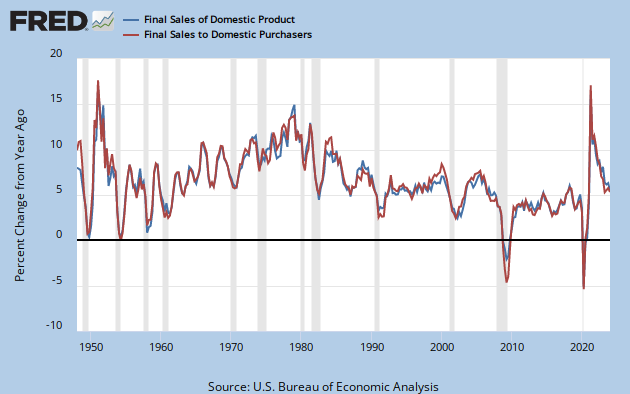
Thanks to Alex Tabarrok, The Economist's Free Exchange blog, Ezra Klein, and Bruce Bartlett my last post on the history of U.S. nominal spending received a lot of attention. It also raised the important question of why we should care about nominal spending. Before I answer this question let me first define nominal spending: it is the current dollar value of total spending in an economy. More simply, it is total demand in an economy. Technically, what I showed in the last post was the growth rate of final sales to domestic purchasers or U.S. domestic demand. One could also look at final sales of domestic product--which includes foreign purchases of U.S. made goods and services--which is aggregate demand for the U.S. economy. Either way, both series show a large collapse in nominal spending late 2008, early 2009 as seen in this figure.

Now on to the importance of nominal spending. I have asserted that the best way for the Fed to reduce macroeconomic volatility is to stabilize nominal spending rather than inflation. Here is why. If an economy is running at full employment, then any sudden increase or decrease in nominal spending will give rise to changes in real economic activity that are not sustainable. This is because there are numerous rigidities that prevent prices from adjusting instantly. There is simply no way to suddenly jar nominal spending (i.e. create a nominal spending shock) and not have real economic activity move as well.

Note that the key here is not to aim for inflation stability, but to aim for nominal spending stability. This is because inflation is merely a symptom of nominal spending shocks. Moreover, inflation can sometimes can be hard to interpret--Is the high (low) inflation due to positive (negative) aggregate demand (AD) shocks or negative (positive) aggregate supply shocks (AS)?--and as a result monetary policy that targets inflation rather than nominal spending may make the wrong call. To illustrate this point, consider the following two cases*:
(1) A central bank has a 2% inflation target and the economy's sustainable (i.e. natural) rate of growth is 3%. Here we have nominal spending growing at 5%. Now imagine that fiscal policy generates a positive AD shock that increases nominal spending and pushes inflation temporarily to 4%. Now nominal spending is growing at 7% and if there are any nominal rigidities (i.e. upward slopping SRAS curve) this increase in nominal spending (or AD) should also push real economic activity beyond its natural rate. Hence, a positive output gap is created and there is an uptick in inflation. In this scenario--where a positive AD shock is the issue--a policy aiming to stabilize nominal spending would have prevented the output gap from emerging. An inflation target regime would have also addressed the output gap, but since inflation is a symptom of the nominal spending shock it only would have done so after the horse was out of the barn, so to speak. Still, in this case inflation targeting would have made the right call.

(2) A central bank has a 2% inflation target and the economy's natural rate of growth is 3%. Once again, nominal spending is growing at 5%. Now assume a permanent productivity innovation pushes the natural rate of real economic growth to 5%. Assume also that the surge in productivity in the absence of any new accommodation or changes in monetary policy--that is, the central bank is still increasing money supply at rate that would have created a 2% inflation target under the old steady state of 3% real growth--would have pushed inflation down to 0%. If the central bank adopts this approach and does not accommodate the increase in productivity, nominal spending will still be at 5% (0% inflation + 5% real growth). Note, there has been no change in AD (still growing at 5%) and thus no movements against the SRAS by which to create an output gap.

Now assume the central doesn't sit idly by but accommodates the productivity shock so that its inflation target is maintained. It will have to stimulate nominal spending such that the potential 2% drop in inflation is avoided. Now nominal spending jumps to 7% from its previous value of 5%. Here, we have a sudden increase in nominal spending (or AD) that in the face of an upward-slopping SRAS will temporarily push output beyond its natural rate. In other words, an positive output gap will emerge. But here there is no observed change in inflation or the inflation target! Had the central bank targeted a 5% nominal spending growth rate this output gap would not have emerged. Instead, its rigid focus on inflation caused it to be too accommodative.
There are other scenarios one could consider, but any way you slice it what becomes apparent is that monetary policy that targets nominal spending can handle both AD and AS supply shocks, while monetary policy that targets inflation can only handle AD shocks. I believe one example of this was the 2003-2004 period when the U.S. economy was buffeted with rapid productivity gains (i.e. positive AS shocks) that led to low inflation. The Fed interpreted this low inflation as indicating weak AD and kept monetary policy extremely loose. They were wrong, nominal spending was soaring by 2003 and thus, monetary policy was too accommodative. I also believe that had the Fed been targeting nominal spending it would been easier for them to avoid the collapse in nominal spending that occurred in late 2008, early 2009. Of course, an explicit inflation target would have helped too but why not go for root of the problem rather than its symptom?

For more on the importance of stabilizing nominal spending I would recommend you take a look at Scott Sumner's blog. Also, here is an article from the St. Louis Fed that provides a more thorough but gentle introduction to the importance of nominal spending and how monetary policy might target it.

* These are variations of scenarios I first posted over at Worthwhile Canadian Initiative.

Thursday, June 19, 2008

Nominal Income Targeting or (More Economic) Bust!

Awhile back I made the case that the Fed could improve macroeconomic stability by adopting a nominal income targeting rule. Such a rule would (1) force the Fed to be more vigilant in stabilizing nominal spending while (2) allowing it to avoid the distraction of rigidly following inflation. Nominal spending shocks, after all, are the real source of macroeconomic volatility while inflation is merely a symptom of these shocks. Moreover, inflation can sometimes can be hard to interpret--Is the high(low) inflation due to positive(negative) aggregate demand shocks or negative(positive) aggregate supply shocks?--and as a result monetary policy that targets inflation may make the wrong call. For example, I noted the following scenario earlier:
Imagine the U.S. economy is buffeted with a series of positive productivity shocks that increases aggregate supply. This development would put downward pressure on the price level and set off the deflation red alert sign at the Federal Reserve. Now, in order to keep the price level from falling, the Federal Reserve must act to increase nominal spending. If this change in monetary policy were unexpected, or if there were significant nominal rigidities (i.e upward sloping Short-run aggregate supply curve), the nominal spending increase that stabilizes the price level would also push actual output beyond its natural rate level. Hence, there would be both a sustainable component—the productivity gains—and a non-sustainable component—the monetary stimulus—to the subsequent increase in real output. Moreover, the unsustainable pickup in actual output would occur without any alarming increases in the price level ... The increase in nominal spending could thus create a boom-bust cycle in real economic activity without any of the standard inflationary signs of overheating.
As I have argued elsewhere, I believe the above scenario is a good description of what happened in the U.S. from 2003-2005. But I digress; the key point is that monetary policy should aim to stabilize the cause of macroeconomic instability rather than a symptom of it.

Now some observers will reply that the Fed is not just focused on an inflation target, but also looks at the the output gap as is mandated by law. So in some sense, it may already be close to following a nominal income targeting rule. While there is some truth to this claim, there still appears to be an implicit inflation target for the Fed that implies when push comes to shove inflation worries will trump any concerns over full employment. The recent inflation hawk talk by Fed Chairman Ben Bernanke is a case in point; other examples include the deflation scares of 1998 and 2003.

Other observers will argue that even if one concedes the advantages of nominal income targeting there still is the difficulty of implementing it: how does one measure nominal income in real time? My answer is that there are monthly measures of real economic activity--coincident index or industrial production--that can be used in conjunction with a monthly price level measure to estimate current nominal income. At a minimum, there is no reason to believe that nominal income targeting would be any harder to implement than a monetary policy following a Taylor rule, which requires ones knows the hard-to-measure in real time output gap.

The importance of stabilizing nominal spending can be seen in the graph below that plots the relationship between the output gap and nominal spending shocks. The output gap is calculated as the percent difference between actual real GDP and the U.S. Congressional Budget Office’s potential real GDP. The nominal spending shocks series is calculated as the deviation of the year-on-year growth rate of quarterly final sales to domestic purchasers from its preceding 10-year moving average. The data cover the period 1953:Q1 - 2008:Q1.


The scatterplot makes it clear there is a strong, positive relationship between nominal spending shocks and the output gap. As a comparison, I have constructed in the same way an inflation shock series from the PCE price index and plotted it below against the output gap.


These figures indicate nominal spending shocks are more closely related to the output gap than inflation shocks. Given these results, I went ahead and plugged the nominal spending shock and output gap series into a vector autoregression (VAR) to get a sense of their dynamic relationship. Five lags were used in the VAR, which is enough to remove serial correlation from the quarterly data (data already in growth rates so no unit roots). After estimating the model and imposing recursive ordering to identify the structural shocks, I got the following impulse response function (IRF) for the output gap given a 1 standard deviation shock to nominal spending:

In plain English, the above figure shows that the typical shock to nominal spending leads to about a 0.5% increase in the output gap--a positive output gap--that persist for about a year and then begins unwinding. Another interesting exercise is to look at the decomposition of the forecast error from the VAR. This exercise explains how much of the forecast error can be attributed to a certain shock. (It tells us whether the interesting results from the IRF really matter)

Here we see that nominal spending shocks account for about 50% of output gap forecast error, a significant amount. By comparison, if the VAR is reestimated with the above inflation shock series instead of the nominal spending shock series, only about 8% of the forecast error can be explained by the inflation shock. Nominal spending shocks matter greatly!

Now I do want to oversell the findings presented here since they are based on a two variable VAR, but they are highly suggestive that nominal spending shocks are more important to macroeconomic stability than inflation shocks. Hence, monetary authorities should pay more attention to nominal spending. Moreover, stabilizing nominal spending should do better than inflation targeting at preventing the buildup of financial imbalances and asset bubbles for reasons explained here. In short, I am big believer that there would be meaningful gains in macroeconomic stability should the Fed should adopt a nominal income targeting rule.

Friday, October 2, 2009

Was it Nominal or Real?

Scott Sumner has been arguing for some time that the current recession mutated from a mild downturn in early 2008 to a sharp contraction in late 2008 and early 2009 because of a nominal shock, not a real one. Specifically, he has been making the case that monetary policy effectively tightened in late 2008 and, as a result, nominal spending collapsed and pulled down an already weakened economy. According to this view, real shocks like the one coming from the financial crisis or the spike in oil prices, which were important in starting the recession, cannot explain the severity of the downturn that began in late 2008. As readers of this blog know, I have been sympathetic to this view as can be seen here and here. Many observers, however, do not buy it or if they do find it plausible refuse to endorse it due to the lack of empirical evidence. This post is my attempt to shed some light on this debate by using some rigorous (albeit imperfect) empirical methods to tease out what shocks drove the collapse in nominal spending. This essay is in some ways an extension of what I did earlier this week, but it is motivated more by the need for empirical evidence. I won't claim it is conclusive, but it is a start.

In order to uncover the shocks that drove the collapse in nominal spending, I turned to a vector autoregression that as a base line model included expected future inflation, nominal spending, and spreads on corporates yields. The expected future inflation data comes from the Philadelphia Fed's survey of economic forecasters, nominal spending is final sales to domestic purchasers, and corporate spreads are the difference between the yield on BAA and AAA corporate bonds. The reasons for using these variables is as follows. First, Scott has been arguing that the collapse of expected future inflation in late 2008 reflected an effective tightening of monetary policy that translated into reduction of current nominal spending. In other words, the market saw deflationary pressures on the horizon and immediately cut back on spending. Second, the corporate spreads provide a convenient measure of the financial crisis and should control for any collapse in nominal spending coming from a negative financial shock. The data for these variables run from 1971:Q1 thru 2009:Q2.

The VAR was specified and estimated in a conventional manner.* With the VAR estimated I then did a historical decomposition which decomposes or attributes the forecast error for a particular series--in this case the nominal spending growth rate--into shocks or non-forecasted movements in other series. In the baseline model, the other series are expected future inflation and the financial crisis. In other words, this exercise shows how much of the non-forecasted movements in nominal spending can be explained by non-forecasted movements in expected future inflation. The figure below graphs the results of this exercise. In this figure, the other series contribution to the forecast error--the difference the actual and forecasted nominal spending growth rate--is shown by the dashed lines. The closer a dashed line is to the solid red line the more of the forecast error is explained by that shock: (Click on figure to enlarge)


In this figure we see that both the expected inflation shock and financial system shock were important in the collapse of nominal spending. At its peak, the expected inflation shock explains 50% of the decline in the nominal spending shock during the time in question. This baseline model, however, ignores the oil shock and its potential contribution to the collapse in nominal spending. The VAR was reestimated, therefore, with oil prices and generated the following results: (Click on figure to enlarge)

Here the expected inflation shock is still important, but now only explains at most 31% of the decline in nominal spending. The financial shock becomes more important and oil itself is non-trivial in explaining the decline in nominal spending.

One problem with the above analysis is that it assumes the change in expected inflation is a good measure of the stance of monetary policy. I have argued elsewhere on this blog that a better measure is the difference between the nominal spending growth rate and the federal funds rates. I redid the model with this measure of the stance of monetary policy and this is what I found: (Click on figure to enlarge)


With this measure, monetary policy explains 95% of the decline in nominal spending for 2008:Q3, 78% in 2008:Q4, and 31% in 2009:Q1. This last figure confirms Scott's story. Of course, it assumes the monetary policy measure outlined above is actually measuring the stance of monetary policy. Note everyone will agree, but I certainly believe it is. To summarize the findings from the above figures the table below list the % contribution to the decline in nominal spending growth rate coming from the different measures representing monetary policy:


*The VAR had 5 lags to remove serial correlations and the variables were all in rate form so no unit root problem.

Update: Scott Sumner responds here.

Thursday, July 30, 2009

Some Thoughts on David Altig's Question

David Altig has a post that summarizes the differing views on what the Taylor Rule is saying about the current stance of monetary policy. He notes that economists from Goldman Sachs, Macroeconomic Advisers LLC, Deutsche Bank Securities Inc. and the San Francisco Federal Reserve Bank view the Taylor Rule as indicating monetary policy is tight while John Taylor, on the other hand, sees the rule as showing the Fed's stance is just about right. Altig suggests that one of the problems in this debate is that the Taylor Rule is based on assumptions about the monetary transmission mechanism that may not hold in the current crisis. Given this possibility, Altig concludes with the following question:
Is the Taylor rule the right tool for discussing the stance of monetary policy at present?
My guess is probably not. For starters, it assumes the parameters defining the relationship between the macroeconomic variables (inflation gap, output gap) and the appropriate federal funds interest rate are constant and linear. While these assumptions worked for the relatively stable 25 or so years during the Great Moderation they seem suspect now given the severity of the economic downturn. Another problem in using the Taylor Rule is that one has to know what is the neutral federal funds rate and the output gap. These metrics are hard to know with precision even in normal times, let alone turbulent economic times as we have now.

Given these challenges with the Taylor Rule, let me suggest an alternative, simple metric for determining the stance of monetary policy. This metric is difference between (1) the growth rate of nominal spending in the U.S. economy and (2) the federal funds rate. Using this metric, the federal funds rate should not deviate too far from the nominal spending growth rate otherwise monetary policy is either too loose (the federal funds rate is significantly below the nominal spending growth rate) or too tight (the federal funds rate is significantly above the nominal spending growth rate). This measure is similar to the one used by The Economist magazine where they gauge the stance of monetary policy by looking at the difference between the nominal GDP growth rate and the federal funds rate. The Economist explains the way to “interpret this [metric] is to see America’s nominal GDP growth as a proxy for the average return on American Inc. If the return is higher than the cost of borrowing, investment and growth will expand [and vice versa].

I however, think, a better way to think about this measure is to view it in terms of nominal spending rather than the return on American Inc. Here is why: stabilizing nominal spending is the key to stabilizing macroeconomic activity. If an economy is running near full employment, then any sudden increase or decrease in nominal spending will give rise to changes in real economic activity that cannot be sustained. This is because there are numerous nominal rigidities that prevent prices from adjusting instantly. There is simply no way to suddenly jar nominal spending and not have real economic activity move as well. Note, that key here is not to aim for price stability, but to aim for nominal spending stability. As I noted before,
Nominal spending shocks, after all, are the real source of macroeconomic volatility while inflation is merely a symptom of these shocks. Moreover, inflation can sometimes can be hard to interpret--Is the high(low) inflation due to positive(negative) aggregate demand shocks or negative(positive) aggregate supply shocks?--and as a result monetary policy that targets inflation may make the wrong call.
The good news is that the Fed can largely shape nominal spending and keep it growing around some target. But to do so means the Fed must not let its federal funds rate be low relative to the growth rate of nominal spending or vice versa.

So what does this policy rate gap look like? Using final sales to domestic purchasers as my measure of nominal spending, I have constructed it two ways: (1) the year-on-year percent change in nominal spending minus the federal funds rate and (2) the annualized quarterly percent change in nominal spending minus the federal funds rate. I have graphed both series below with the NBER recessions in gray bars. The figure goes through 2009:Q1. (Click on the figure to enlarge.)


This figure indicates this measure is consistent with commonly held views about the stance of monetary policy historically. For example, the easing of policy in the 1970s is apparent as is the tightening in the early 1980s. This figure also shows a very accommodative monetary stance in the early-to-mid 2000s. Finally, it shows that through the last few quarters ending in 2009:Q1 monetary policy appears to have been effectively tightening. This is because even though the federal funds rate did not change, nominal spending collapsed creating a large gap between the two series. The fall in nominal spending can seen in the figure below. (Click on figure to enlarge.)

While the policy rate gap is probably not a perfect measure of monetary policy's stance, it is simple to construct and has some predictive power as seen in the figure below. In this figure, the policy rate gap is graphed along with the CBO output gap 3 quarters ahead.

The policy rate gap appears to granger cause the CBO output gap. Such a pattern in the data could easily be explained by macro model where nominal spending shocks that encounter nominal rigidities create create output gaps. I find this to be a promising way to evaluate the stance of monetary policy and hope to do more with it.

Friday, July 10, 2009

Another Way to View the Crisis: A Boom-Bust Cycle in Global Nominal Spending

Many observers, including myself, have spent many hours thinking about the source of the current economic crisis. Much of the discussion in this debate has centered on the role played by the list of suspects rounded up so far: a saving glut in emerging economies, excessive fiscal and monetary policy stimulus in advanced economies, the securitization of finance, underestimating aggregate risk, the lowering of lending standards, the failings of rating agencies, aggressive lending tactics, and poor choices made by lenders. The truth is some mix of all of these played a role. That makes it difficult to apportion responsibility (or blame) accurately and, thus, makes it challenging to draw the appropriate lessons from this crisis moving forward. So in an attempt to simplify matters, this post presents the economic crisis from a different perspective.

So what is this perspective? This approach begins with the understanding that the key to macroeconomic stability--whether nationally or globally--is to stabilize nominal spending. If an economy is running near full employment, then any sudden increase or decrease in nominal spending will give rise to changes in real economic activity that fall outside its natural rate area (i.e. is unsustainable). Why? Because there are numerous nominal rigidities that prevent prices from adjusting instantly. There is simply no way to suddenly jar nominal spending and not have real economic activity move as well. Note, that key here is not to aim for price stability, but to aim for nominal spending stability. As I noted before,
Nominal spending shocks, after all, are the real source of macroeconomic volatility while inflation is merely a symptom of these shocks. Moreover, inflation can sometimes can be hard to interpret--Is the high(low) inflation due to positive(negative) aggregate demand shocks or negative(positive) aggregate supply shocks?--and as a result monetary policy that targets inflation may make the wrong call.
Now apply this thinking to the global economy. From 1980-2002 global nominal spending (as measured by world nominal GDP) in current U.S. dollars grew about 5.0% a year. In PPP current international dollars it grew 6.1% a year. Suddenly, in the period 2003-2007 those numbers jumped to 10.7% and 7.5%. (Data from WEO databse April 2009.) This surge in global nominal spending was sudden and most likely unexpected given the trends for the 1980-2002 period. These developments can be seen in the figure below: (Click on figure to enlarge.)


In short, the world experienced a nominal spending boom over the years 2003-2007 that was unsustainable. Today, the excesses related to that boom are being worked out.

Now why bring up this perspective? Because I believe it has clear policy implications: policy makers should be watching nominal spending both at home and across the globe. Focusing too narrowly on inflation caused policymakers to miss this surge in nominal spending. Two institutions in particular should be watching global nominal spending. First, the IMF should be monitoring global nominal spending given its objectives for global financial stability. Second, the Federal Reserve should also be closely monitoring global nominal spending because (1) it is a monetary superpower and can currently shape to some degree global nominal spending and (2) it has also an enhanced mandate for financial stability. Stabilizing global nominal spending will not eliminate all financial risk, but it will go along way in preventing the buildup of economic imbalances.

Sunday, August 2, 2009

More On the Importance of Nominal Spending Shocks

Scott Sumner has a new article that provides a nice follow up to my previous post where I argued that stabilizing nominal spending rather than inflation is the key to macroeconomic stability. Scott similarly argues that inflation targeting is a poor option for monetary policy compared to nominal income targeting. After reading his post, I was reminded of some quick and dirty empirical analysis I did on this blog that lends support to this view. Here is an excerpt:
The importance of stabilizing nominal spending can be seen in the graph below that plots the relationship between the output gap and nominal spending shocks. The output gap is calculated as the percent difference between actual real GDP and the U.S. Congressional Budget Office’s potential real GDP. The nominal spending shocks series is calculated as the deviation of the year-on-year growth rate of quarterly final sales to domestic purchasers from its preceding 10-year moving average. The data cover the period 1953:Q1 - 2008:Q1.


The scatterplot makes it clear there is a strong, positive relationship between nominal spending shocks and the output gap. As a comparison, I have constructed in the same way an inflation shock series from the PCE price index and plotted it below against the output gap.


These figures indicate nominal spending shocks are more closely related to the output gap than inflation shocks. Given these results, I went ahead and plugged the nominal spending shock and output gap series into a vector autoregression (VAR) to get a sense of their dynamic relationship. Five lags were used in the VAR, which is enough to remove serial correlation from the quarterly data (data already in growth rates so no unit roots). After estimating the model and imposing recursive ordering to identify the structural shocks, I got the following impulse response function (IRF) for the output gap given a 1 standard deviation shock to nominal spending:

In plain English, the above figure shows that the typical shock to nominal spending leads to about a 0.5 percentage point increase in the output gap--a positive output gap--that persist for about a year and then begins unwinding. Another interesting exercise is to look at the decomposition of the forecast error from the VAR. This exercise explains how much of the forecast error can be attributed to a certain shock. (It tells us whether the interesting results from the IRF really matter)

Here we see that nominal spending shocks account for about 50% of output gap forecast error, a significant amount. By comparison, if the VAR is reestimated with the above inflation shock series instead of the nominal spending shock series, only about 8% of the forecast error can be explained by the inflation shock. Nominal spending shocks matter greatly!

Now I do want to oversell the findings presented here since they are based on a two variable VAR, but they are highly suggestive that nominal spending shocks are more important to macroeconomic stability than inflation shocks. Hence, monetary authorities should pay more attention to nominal spending. Moreover, stabilizing nominal spending should do better than inflation targeting at preventing the buildup of financial imbalances and asset bubbles for reasons explained here. In short, I am big believer that there would be meaningful gains in macroeconomic stability should the Fed should adopt a nominal income targeting rule.
Here is the original post.

Monday, January 17, 2011

Having My Cake and Eating it Too

 Tim Duy and Andy Harless call me out for being critical of the the Fed's low interest rates in the early-to-mid 2000s and for being critical of the Fed for failing to stabilize total current dollar spending.  They say I cannot have it both ways.  They argue that in order to keep nominal spending stable in the early-to-mid 2000s, the Fed had to push the federal funds rate below its neutral rate level for an extended period.  Therefore, it is unfair for me to assign blame to the Fed for the credit and housing boom.  Scott Sumner and Bill Woolsey have also raised this question to me in the past.  So what do we make of it? I am being inconsistent?  

Though it may not convince everyone, there is a way to reconcile my two criticisms of the Fed.  The key to doing so is appropriately specifying the trend growth of nominal spending. I will define it here as the trend growth rate over the 1987-1998 period for several reasons.  First, its the part of the Greenspan period where there were no wide, unsustainable swings in economic activity.  Second, 1998 is when the Greenspan Fed for the first time significantly deviated from past practice by lowering the federal funds rates even though the economy was experiencing robust economic growth.  (Robert Hetzel argues in his book that the easing actually started in 1997 when the Fed failed to raise interest rates. See his chapter 16, Departing from the Standard Procedures.) The reasons for the easing were concerns that the global economic turmoil would spill over into the U.S. economy.  

With this trend, I now look to see how nominal spending has subsequently fared using two different measures in the figures below.  The first figure shows domestic total current dollar spending.  This is the narrower of the two measures of nominal spending since it leaves out foreign spending on the U.S. economy.  However, it is appropriate for looking at spending by U.S. residents: (Click on figure to enlarge.)


This figure reveals that there were two above-trend surges in nominal spending, one at the end of the 1990s and the other during the credit and housing boom.  The first nominal spending boom is consistent with the tech-bubble and the Fed's easing in the late 1990s.  Interestingly, the 2001 recession simply returns nominal spending to trend.  The second boom is the one in question and is much larger.  Note, that despite this boom nominal spending is now below trend and is increasingly moving away from it.  Thus, the Fed has failed to restore trend level nominal spending.   This failure amounts to monetary tightening.  QE2 is simply an imperfect attempt to bring the U.S. economy back to the trend.

The next figure shows all nominal spending on the U.S. economy, including that of foreigners.  This figure shows a similar picture though the nominal spending booms are little larger.  (Click on figure to enlarge.)


The monetary tightening is less pronounced in this figure, but it is still there.  Both figures imply there needs to be several periods of catch up nominal spending growth. Both figures also imply that the Fed allowed nominal spending to grow too fast in the early-to-mid 2000s.  Returning current dollar spending to trend would be much easier if the Fed would commit to an explicit nominal spending rule that would help shape expectations. 

Tuesday, November 1, 2011

Some Evidence on the Importance of Expectations

Modern macroeconomics tells us that expectations are crucial to economic decision making.  It is not hard to see why.  Imagine someone is going to get a big pay raise next year and it will be permanent going forward.  It is highly likely that as a result of this change the person will increase his spending today, all else equal. I see this scenario every year with college students who have landed a job, but have yet to start working and get a paycheck. They feel more financially secure and start making bigger purchases such as a new car.

Now think about all those households that are being financially cautious because they are uncertain about their investments and job prospects in the future. If suddenly they feel more secure about their future incomes, they too will start spending more. Same thing for firms sitting on cash. Improve their forecast of sales and they will start hiring more workers and building more plants to meet that expected rise in demand for their goods.  

This is why expectations is such a big part of modern macroeconomics. And it is why the Fed could pack more of punch if it did a better job managing expectations about future nominal spending (and by implication inflation) via a nominal GDP level target.  Now the Fed would probably need to back up its announcement for higher nominal spending with additional asset purchases, but if taken seriously the public would do much of the heavy lifting. That is, households and firms would start rebalancing their portfolios away from safe, liquid assets toward riskier, higher yielding ones that would create positive balance sheet and wealth effects for spending.  Some of the portfolio rebalancing would go toward capital assets that would directly affect spending.  These developments would improve the economic outlook and that, in turn, would further reinforce the decision to spend more today.

But some folks are not convinced.  They want more than stories.  They want evidence that by changing expectations the Fed can change current nominal spending.   Here is my attempt to provide some evidence on this question.  It is brief and much more could be done, but I think it should be sufficient to give the skeptics pause.

First, many observers have documented that FDR changed nominal expectations at the depths of the Great Depression by talking up a price level target and backing it up by devaluing the gold content of the dollar.   Gautti Eggertson probably has the best known piece on how expectations were crucial to this experience, but also see here for how the change in expectations influenced nominal spending.  What is remarkable about this experience is that FDR was able to turn around expectations despite almost three and half years of deflation and economic collapse.  That FDR could do this in such dire circumstances suggests it could be done today.

Second, it is fairly straightforward to empirically demonstrate that both inflation expectations and nominal spending expectations have been important to current nominal spending.  This can be done using the quarterly Survey of Professional Forecasters from the Philadelphia Fed.  This survey has inflation and nominal GDP forecasts for the next five quarters that go back to 1968:Q4.  The next two figures show that if one takes the average forecast for the next four quarters and plots it against the actual subsequent nominal GDP growth that occurred over the next year there is a systematic relationship:


Now the relationship is not perfect--you wouldn't expect it to be because subsequent shocks could come along over the next year--but it is strong enough to suggest expectations about the future do influence current spending decisions.  Plotting the forecasts against just the current quarter (whose value is unknown at the time of forecast) yields similar results. 

Now since the above data is in growth rate form, we don't have to worry about spurious relationships emerging from trends.  We might, however, wonder if these figures are picking up some kind of serial correlation coming from an omitted variable.  In order to address this question, I ran ran a vector autoregression (VAR) that had as variables the forecasted nominal GDP growth rate for the next year (same as above) and the current quarter nominal GDP growth rate (annualized).  Five lags were used since this many is sufficient to whiten the residuals and get rid of any serial correlation.  The VAR also allows me to answer this important question: what happens to the current nominal GDP growth rate when there is an unexpected change in its forecasted growth rate over the next year?  (These unexpected changes or shocks to the nominal GDP forecasts are those movements in the forecast that could not have been predicted by changes in its own past values or by changes in the past values of actual nominal GDP.)  

The next two graphs answer this question.  The first one shows what happens to the forecasted nominal GDP  growth rate for the next year following a typical (i.e. one standard deviation) shock to the forecast.  It reveals that, on average over the 1968:Q4-2011:Q3 period, such shocks cause the forecasted nominal GDP growth rate to increase about 0.73 percentage points upon impact and then slowly decline after that. 


Now the above figure is not what we are really after.  What we want to see is the response of actual nominal GDP.  But the above figure is important because it provides a way for us to compare the size of the change in the forecasted nominal GDP growth rate to the size of the change in the actual nominal GDP growth rate following such a shock.  So what does the typical, actual nominal GDP growth rate response look like?  Here is the answer:


This figure shows that the typical forecast shock of 0.73 percentage points causes the actual nominal GDP growth rate to increase about 1.50 percentage points upon impact.  In other words, current nominal spending is very sensitive to changes in forecasted nominal GDP.  The actual nominal GDP growth rate response remains elevated for about two quarters after the shock and then gradually declines.  The VAR was rerun with the GDP deflator inflation forecast instead of the nominal GDP forecast.  Upon impact, the  typical forecast shock caused expected inflation to increase 0.35 percent while the nominal GDP growth rate response increased 0.68 percentage points.  Here to current nominal spending is very sensitive to changes in expected inflation.  

To summarize, the evidence from the scatterplots and the vector autoregressions indicates that current dollar spending is very sensitive to changes in both expected inflation and expected nominal spending.  These findings suggest, then, that if the Fed did adopt a nominal GDP level target--something that would definitely jolt expectations--it is likely that nominal spending would respond quickly and meaningfully.   

Wednesday, December 22, 2010

The Case for Nominal GDP Targeting

I am late getting to this, but Mark Thoma wants to hear the case for nominal GDP targeting.  This approach to monetary policy requires the Fed stabilize the growth path for total current dollar spending.  As an advocate of  nominal GDP level targeting, I am more than happy to respond to Mark's request.  I will  focus my response on what I see as its  three most appealing aspects: (1) it provides a simple and intuitive approach to monetary policy, (2) it focuses monetary policy on that over which it has meaningful influence, and (3) its simplicity makes it  easier to implement  than other  popular alternatives. Let's consider each point in turn.

(1) It provides a simple and intuitive approach to monetary policy.   This first point can be  illustrated by considering the following scenario. Imagine the U.S. economy is humming along at its full potential.  Suddenly a large negative shock, say a housing bust, hits the economy.  This development leads to a decline in expectations of  current and future economic activity.  As a result, asset prices decline,  financial conditions deteriorate, and there is a rush for liquidity.  The rise in demand for liquidity means less spending by households and firms and thus, less total current dollar spending in the U.S. economy.  Because prices do not adjust instantly, this drop in nominal spending causes a decline in real economic activity too.  Thus, even though the primal cause of the decline in the real economy was the housing bust, the proximate cause  was the drop in total current dollar spending.  The Fed cannot undo the housing bust, but it can prevent the drop in total current dollar spending by providing enough liquidity to offset  the spike in liquidity demand.  If nominal spending has not been stabilized then the Fed has failed to do this.  A nominal GDP target, then, is simply a mandate for the Fed to stabilize total current dollar spending.

Though a simple objective, stabilizing nominal spending is key to macroeconomic stability. The figure below shows that changes in the growth rate of total current dollar spending (i.e. nominal GDP)  got transmitted mostly to changes in the growth rate of real economic activity (i.e. real GDP) rather than inflation (i.e. GDP Deflator).  This implies that had monetary policy done a better  job stabilizing nominal spending then there would have been fewer recessions during this time. (Click on figure to enlarge.)


(2) It focuses monetary policy on that over which it has meaningful influence. There are two types of shocks that buffet the economy: aggregate supply (AS) shocks and aggregate demand (AD) shocks.  A nominal GDP targeting rule only responds to AD shocks.  It ignores AS shocks while keeping total current dollar spending growing at a stable rate.  This is the way it should be.  For if monetary policy attempts to offset AS shocks it will tend to increase macroeconomic volatility rather than reduce it.  For example, let's say Y2K actually turned out to be hugely disruptive for a prolonged period. This negative AS shock would reduce  output and increase prices.  A true inflation targeting central bank would have to respond to this negative AS shock by tightening monetary policy, further constricting the economy. A nominal GDP targeting central bank would not face this dilemma. It would simply keep nominal spending stable.

In general, any kind of price stability objective for a central bank is bound to be problematic because price level  changes can come from either AD or AS shocks and are hard to discern.  For example, was the low U.S. inflation in 2003 the result of  a weakened economy (a negative AD shock) or robust productivity gains (a positive AS shock)? It makes much more sense to focus on the underlying economic shocks themselves rather than a symptom of them (i.e. price level changes).  Nominal GDP targeting does that by focusing just on AD shocks. This point is graphically illustrated here using the AD-AS model. More discussion on this point can be found here.

(3) Its simplicity makes it easier to implement  than other  popular alternatives. This is true on many front.  First, a nominal GDP target requires only a measure of the current dollar value of the economy.  It does not require knowledge of the proper inflation measure, inflation target, output gap measure, the neutral  federal fund rate, coefficient weights, and other elusive information that are required for inflation targeting and the Taylor Rule.  There will always be debate on which form of the above measures is appropriate.  For example, should the Fed go with the CPI or PCE, the headline inflation measure or the core, the CBO's output gap or their own internal estimate, the original Taylor Rule or the Glenn Rudebush version, etc.? A nominal GDP target avoids all of these debates.  

Second, nominal GDP targeting would also be easier to implement because it is easy to understand.  The public can comprehend the notion of stabilizing total current dollar spending. It is less clear they understand  output gaps, core inflation, the neutral federal funds rate, and other esoteric elements now used in monetary policy.  The Fed would have a far easier time explaining itself to congress and the public if it followed a nominal GDP target. On the flip side, this increased understanding by the public would make the Fed more accountable for its failures. 

Third, a nominal GDP target would take the focus off of inflation and what its appropriate value should be. Thus, if there needed to be some catch-up inflation and nominal spending to get nominal GDP back to its targeted growth path the Fed could do it with less political pressure. 

Some folks argue that the nominal GDP targeting is nothing more than just a special case of a Taylor Rule. Maybe so, but they miss the bigger point that nominal GDP targeting is a far easier approach to implement for the reasons laid out above.  Moreover, in practice the Fed has deviated from the Taylor Rule and during these times it appears to be more of a pure inflation targeter.  Thus, adopting an explicit nominal GDP target would force the Fed to stick to stabilizing nominal spending at all times. 

Ultimately, I would like to see the Fed adopt not only a nominal GDP level target, but a forward-looking one that targeted nominal GDP futures market.  This is an idea that Scott Sumner and Bill Woolsey have been promoting for some time. See here and here for more on this proposal.

Friday, October 2, 2009

What Was the Stance of Monetary Policy Late Last Year?

How does one best measure the stance of monetary policy? There are many ways to answer this question and, as a result, there are often many differing views on the stance of monetary policy. This issue came up at Cato Unbound's discussion on monetary lessons from the crisis when Scott Sumner argued that the reason the economy tanked in late 2008 and early 2009 was because tight monetary policy caused nominal spending to crash. Jeffrey Rogers Hummel disagreed; he contended that it was not tight monetary policy per se, but a collapse of velocity (i.e. increase in real money demand) that caused the fall in nominal spending. Here is Scott's reply:
[E]conomists are all over the map as to what the terms “easy money” and “tight money” really mean. In that case I am inclined to throw up my hands and ask this pragmatic question:

In a fiat money world where the central bank has almost limitless ability to pump money into the economy, and impact the expected growth of nominal aggregates, what is the most useful definition of the stance of monetary policy?

Since I believe that the Fed should target the expected growth rate of NGDP on a daily basis, I decided the most useful way to think of “easy money” was as a policy expected to lead to above-target nominal growth, and vice versa. Is this so unusual? I notice that those who favor targeting interest rates (Keynesians) define the stance of monetary policy in terms of interest rates. And I notice that many who favor targeting the money supply (monetarists) tend to define the stance of monetary policy in terms of the money supply. I prefer to target NGDP expectations. So that’s my policy indicator.
What I think Sumner is saying is that no matter what the source of volatility in nominal spending, its the Fed's job to counteract and stabilize it. In late 2008 the Fed should have been more aggressive in responding to the fall in velocity. By not doing so, Sumner is arguing monetary policy effectively was tight. I agree and have some evidence to support this view.

My evidence is based on what I consider to be a useful metric for the stance of monetary policy. This metric is difference between (1) the growth rate of nominal spending in the U.S. economy and (2) the federal funds rate. Using this metric, the federal funds rate should not deviate too far from the nominal spending growth rate otherwise monetary policy is either too loose (the federal funds rate is significantly below the nominal spending growth rate) or too tight (the federal funds rate is significantly above the nominal spending growth rate). So what does this metric look like? Using monthly nominal GDP as my measure of nominal spending I have constructed it as follows: the year-on-year percent change in nominal spending minus the federal funds rate. Here is what this series looks for the period 1993:1 - 2009:7 (Click on figure to enlarge):


Note that I have highlighted two periods in red where there was a marked spread between the nominal spending growth rate and the federal funds rate. They just so happen to be the housing boom period and the mini-great contraction period Scott Sumner has been discussing. In the former case monetary policy was too loose while in the later is was too tight.

Unfortunately the monthly GDP data only go back to 1992. However, I created the same series on a quarterly basis back to 1961. This time I used final sales to domestic purchasers as my measure of nominal spending. I took this series and plotted it against the output gap series lagged 5 quarters.*


There is surprisingly strong relationship here: almost 60% of the variation in the output gap 6 quarters ahead can be explained by current variation in this monetary stance measure. Monetary policy does matter--take note Arnold Kling--and its stance can be easily determined by this metric.

*I used the output gap measure from John Williams et al. of the San Francisco Fed. See here for why it appears to be a better measure than the CBO's output gap.

Thursday, May 5, 2011

Is the Equation of Exchange Still Useful?

Matt Rognlie says no.  Nick Rowe says yes and I agree. Nick Rowe argues MV=PY (where (M = money supply, V = velocity, PY = nominal GDP) is useful because it highlights the fact that money is special: it is the only asset on every other market (i.e. it is the medium of exchange) and thus is the only one that can affect every other market.  Money, therefore, is what makes it possible to have economy-wide recessions.  Even in the recent recession where the financial crisis increased the demand for safe assets, it was not the elevated demand for safe assets itself that caused the recession but the fact that this demand for safe assets was met, in part, by going after the safe asset money.

I view the equation of exchange as useful because it provides a summary measure of what is causing swings in nominal spending and the role, if any, monetary policy is playing in those swings.  For example, the equation of exchange in its expanded form sheds a lot of light on what caused the crash in nominal spending during late 2008, early 2009.  It also explains why the subsequent recovery  in nominal spending has been sluggish.

Monday, November 16, 2009

Assorted Monetary Musings

Here are some assorted monetary musings:

(1) Paul Krugman comes clean and acknowledges unconventional monetary policy can still pack a punch. In fact, he says the "first-best answer" to our current economic crisis is not expansionary fiscal policy, but a credible commitment by the Federal Reserve to higher inflation. An exasperated Scott Sumner who has been making this case for some time wonders why Krugman has taken so long to acknowledge this point. Krugman replies that he has not pushed this idea because he believes it will not get any traction. As a result he turned to expansionary fiscal policy as a second-best solution. In other words, Krugman believes he faces the following tradeoff regarding aggregate demand-stabilizing policies:

Krugman may be right on this policy tradeoff. But given Krugman's immense political influence, he could have made this issue front and central for policymakers. And with enough exposure unconventional moneary policy could have become a first-best political solution too. In short, had Krugman been pushing this idea some time ago it may have gone a long way in preventing the collapse in nominal spending over the past year. Moving forward, it is good to remember that it was unconventional monetary policy (and not fiscal policy) that ended the Great Contraction of 1929-1933. So too can it now keep the U.S. economy from entering a prolonged slump.

2. Speaking of Scott Sumner, I did a long run yesterday and listened to his podcast with Russ Roberts to pass the time. It was good interview and covered many of the same issues Scott has made on his blog. One of the points he made is that monetary policy could improve its ability to stabilize the macroeconomy by targeting some measure of nominal spending. I too am an advocate of the Federal Reserve stabilizing nominal spending for the same reasons. However, I am a little less confident that it is always a sufficient policy response in terms of stabilizing the macroeconomy. For example, if we look at the period called the "Great Moderation" that occurred during the 25+ years prior to the current crisis, we see the Federal Reserve did a fairly good job on average of stabilizing nominal spending around 5% growth (See this figure). However, this time was also a period of the Fed asymmetrically responding to swings in asset prices. Asset prices were allowed to soar to dizzying heights and always cushioned on the way down with an easing of monetary policy. This behavior by the Fed appears in retrospect to have caused observers to underestimate aggregate risk and become complacent. It also probably contributed to the increased appetite for the debt during this time. These developments all contributed to current crisis. To the extent, then, that stabilizing nominal spending requires the Fed to respond as it did to swings in asset prices during this time, then it becomes less clear to me that targeting nominal spending is always a sufficient condition for macroeconomic stability. Don't get me wrong, I still believe a nominal spending target would have done much to prevent the collapse in nominal spending over the past year and ultimately it would be an improvement over current Fed policy. The gradual buildup of excesses during the "Great Moderation", though, suggest to me that something more is needed. That is why I see a two part approach to macroeconomic stability: (1) target nominal spending and (2) implement macroprudential regulations.

2. It was a really long run so I also listened to a podcast where Bloomberg's Tom Keene interviewed Bruce Bartlett about his new book The New American Economy. It was an interesting interview, but at one point Bartlett claimed there was nothing more monetary policy could for the economy at this point. Apparently, Bartlett has not been reading Scott Sumner's blog. Bartlett also said of all economists he finds Krugman to make the most sense on the current crisis. If so, then there is hope for Bartlett given Krugman's admission that unconventional monetary policy can still work as noted above.

3. Bill Woolsely has had some great recent posts on monetary economics. First, he reminds us that we should not confuse money with credit. Second, he responds to Bryan Caplan's post on velocity by, among other things, coming to defense of the equation of exchange as being more than a trivial tautology. I agree with him that the equation of exchange is useful in thinking about monetary economics and have used it here before on this blog.

4. Francois R. Velde has a new paper on the recession of 1937. It is probably the best paper I have seen on the on this recession and makes a great policy implication for today: beware of tightening policy too soon in the recovery. Below is a figure from the paper that shows a historical decomposition of the recession. It comes from a vector autoregression that decomposes or attributes the forecast error for industrial production into non-forecasted movements in other series. Here, the other series are monetary policy as measured by M1, fiscal policy as measured by fiscal balance, and labor costs as measured by wages. In this figure, these series contribution to the forecast error--the difference between actual and forecasted (i.e. baseline) values-- of industrial production is shown by their own colored lines. For example, the closer the baseline + M1 line is to the solid black line (i.e. actual industrial production) the more of the forecast error is explained by monetary policy: (Click on figure to enlarge)


This figure makes clear that tight monetary and fiscal policy explain most of the 1937 recession. Read the paper here.

Monday, April 4, 2011

How QE2 Worked

Paul Krugman has a post explaining the monetary policy transmission channels for QE2. His explanation is that there was a rise in wealth effect-driven consumption spending via the rising stock market and a rise in foreign spending on the U.S. economy via the depreciated dollar.  While true, there is a far richer story to tell with the portfolio rebalancing channel of monetary policy. Here is how I described it before:
Currently, short-term Treasury debt like T-bills are near-perfect substitutes for bank reserves because both earn close to zero percent and have similar liquidity.  In order for the Fed to get investors to spend some of their money holdings it must first cause a meaningful change in their portfolio of assets.  Swapping T-bills for bank reserves will not do it because they are practically the same now. In order to get traction, the Fed needs to swap assets that are not perfect substitutes.  In this case, the Fed has decided to buy less-liquid, higher-yielding, longer-term Treasury securities.  Doing so should lower the average maturity of publicly-held U.S. debt.  It should also overweight investor's portfolios with highly-liquid, lower-yielding assets and force investors to rebalance them.  In order to rebalance their portofolios, investors would start buying higher-yielding assets like stocks and capital.  This would ultimately drive up consumption spending--through the wealth effect--and investment spending.  The portfolio rebalancing, then, ultimately cause an increase in nominal spending.  Given the excess economic capacity, this rise in nominal spending should in turn raise real economic activity.  
Note that the rise in stock prices and the drop in the dollar's value all  occur as result of the portfolio rebalancing above.  This description so far, however, is incomplete because it ignores the effect of expectations on the portfolio adjustment channel:
If the Fed could convince investors that it is committed to the objective of higher nominal spending and higher inflation... then much of the rebalancing could occur without the Fed actually buying the securities.  For if investors believe there will be a Fed-induced rise in nominal spending that will lead to higher real economic growth and thus higher real returns, they will on their own accord start  rebalancing their portfolios toward higher yielding assets. Likewise, if investors anticipate higher inflation, then the expected return to holding money assets declines and causes them to rebalance their portfolios toward higher yielding assets.  In other words, by properly shaping nominal expectations the Fed could get the market to do most of the heavy lifting itself.
What is remarkable is that QE2 has done as much as it has given that (1) the U.S. Treasury has been undermining QE2 by increasing the average maturity of the U.S. debt and (2) QE2 being implemented in a less than optimal fashion.  It must be that QE2's ability to rebalance portfolios and improve the economy has come largely from its changing of  expectations as outlined above.

Update I: Here is a figure showing how QE2 has changed expected nominal spending growth:


While there is a marked improvement, the need for catch-up growth to return  nominal spending to its trend means the rise in expected nominal spending growth is far from adequate.

Update II:  Marcus Nunes shows that Fed policy (including QE2) over the past few years  has been constrained by the "memory-less" nature of inflation targeting.

Friday, November 4, 2011

A Win-Win for Conservatives and Liberals

Ramesh Ponnuru and I have a new article in The New Republic where we argue that conservatives should embrace more aggressive monetary policy while liberals should not fear budget tightening.  Our point is that the Fed could be doing far more to restore robust nominal spending and if it did so, it would be possible to do fiscal consolidation without harming the economy. For example, if the Fed were targeting nominal GDP and government spending cuts proved to be contractionary, then the Fed would offset them so as to maintain a stable nominal GDP growth rate.  It is a win-win situation.  Conservatives get fiscal consolidation and liberals get a meaningful boost to aggregate demand.

Joe Weisenthall objects by arguing the following:
The biggest problem facing the economy is that the private sector is in too much debt. Americans are trapped in their homes, where they owe huge mortgages, and are generally paying off the big credit boom from the last few decades...If you can accept that this needs to come down, it seems ludicrous to think that the answer to the debt crisis is: cheaper loans!
Two responses.  First, nowhere have we argued that indebted households should take on additional borrowing.  Rather, monetary easing via a nominal GDP level target would make its biggest impact, in our view, via changes in expectations that would cause households to rebalance their portfolios in a way that would stimulate spending.  Bank lending and borrowing are not key to this story.  And yes, there is ample evidence that expectations do affect spending decisions. 

Second, while the buildup of household debt is a drag for debtors it does not have to be for the economy as a whole.  If the monetary authority is able to maintain stable nominal spending expectations--that is minimize uncertainty about future nominal income growth--then the creditors should provide a boost to spending that offsets the debtors' reduction in spending.  The "balance sheet recession" view ignores this possibility and ignores the historical examples where this actually happened.  Moreover, a closer look at household balance sheets reveals that the real problem constraining aggregate demand is on the asset side, not the liability side. That is, what best explains in a systematic manner spending changes is the household share of liquid assets not its debt to income ratio.  But even so, a rise in nominal income from adopting a nominal GDP target would make it easier for indebted households to service their liabilities.

Finally, Joe Wiesenthall is troubled with our claim that the fiscal policy multiplier is zero.  Let me explain this claim using this analogy I made in the past:
Scott Sumner once compared arm wrestling with his daughter to the relationship between monetary and fiscal policy.  Scott explained that no matter how hard his daughter tried to win the arm-wrestling contest he would always apply just enough pressure to offset her efforts and keep her in check.  Likewise, no matter how hard fiscal policy may attempt to stimulate aggregate spending the Fed has the ability to offset such actions and place aggregate demand where it so chooses.  In other words, the size of the fiscal multiplier ultimately depends on the stance of monetary policy.
Since the Fed could do more by its own admission and yet seems content doing nothing at the moment, it stands to reason that a fiscal policy stimulus that lead to enough rapid nominal spending growth to close the output gap would be quickly arrested by the Fed.  The problem, then, is with the Fed.  A nominal GDP level target would change the Fed's perspective so that it would allow enough nominal spending growth to return  nominal GDP to some pre-crisis trend.  Fiscal policy in such a setting would be more effective, but then it wouldn't be needed because the Fed itself would be pushing nominal GDP to its target growth path.  

For further comments on our article see Rameh Ponnuru's comments here and here