Pages

Wednesday, July 28, 2010

Is It Structural or Cyclical Unemployment?

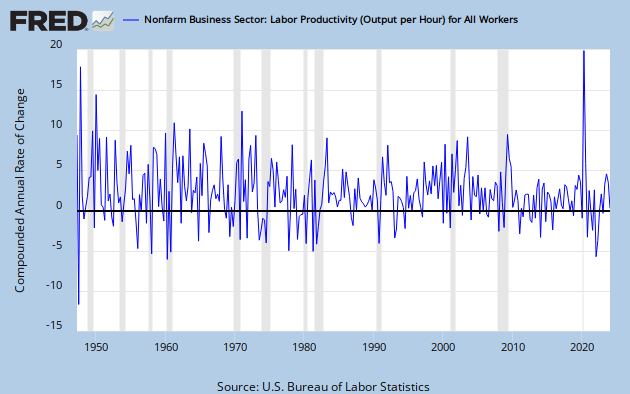
The Economist magazine is asking whether there has been an increase in America's structural unemployment. If the answer is yes then macroeconomic policy may be limited in how much it can do to lower unemployment. Thus, even if the Fed further stabilized aggregate demand the benefits for the unemployed and  the broader economy may be muted.  My own view has been that both structural and cyclical unemployment have been important in this economic cycle. On one hand, the the rapid productivity gains in 2009 (they are down in 2010) point to increased structural unemployment, a point recently made by David Altig. On the other hand, there is evidence consistent with a slowdown in aggregate demand which points to increased cyclical unemployment.

So how important are these two forms of unemployment?  Justin Weidner and John C. Williams of the San Francisco Fed have a note that helps answer this question.  In the note the authors look at the various measures of the output gap and via Okun's Law, the implied natural rate of unemployment.  Now the natural rate of unemployment is the sum of frictional unemployment and structural unemployment.  Frictional unemployment, which is a function of search costs, most likely hasn't changed that much.  Thus, any change in the natural rate of unemployment is probably coming from changes in structural unemployment.  Below are unemployment tables constructed from the different measures of the output gap discussed in this note.  The first table shows the implied natural rate of unemployment and the second one shows the implied cyclical rate of unemployment (i.e. actual unemployment rate minus the natural rate of unemployment).  Click on the figure to enlarge it:


What this table indicates is that since 2008:Q4 cyclical unemployment has been hovering around 3.0% while the natural rate has been growing steadily and now is around 6.8%. This data, if correct, suggests that folks like me who call on the Fed to do more in terms of stabilizing aggregate demand should realize the limits of macroeconomic policy.  Still, providing a stable monetary and aggregate demand enironment in which the structural adjustments can take place should not be overlooked.

Tuesday, July 27, 2010

Religiosity and the Business Cycle, Again

Ryan Avent and and Ezra Klein both take note of this Lisa Miller article in Newsweek that discusses what appears to be countercyclical  religiosity.  Here, religiosity is measured by church attendance.  If you read the piece you may note that it addition to citing Daniel Hungerman, an economist who is known for his scholarly work on the economics of religion, it also briefly  quotes me.  If you noticed this quote in the article you  probably wondered to yourself "What the heck is Beckworth doing in this piece? Isn't he the Fed-criticizing, nominal GDP-target loving, saving-glut thesis critiquing macroeconomist who blogs from Texas?" Well, yes but it also just so happens that a few years ago I dabbled in the economics of religion where I specifically looked at the relationship between the business cycle and religiosity.  My timing was impeccable given the arrival of the Great Recession and as result my research got some media attention. That is why I got cited in the Newsweek piece. 

In my first foray into this issue I found that religiosity--as measured by weekly attendance and membership growth--was countercyclical especially for folks who hold more absolute beliefs. In my second foray I expanded my study of the business cycle-religiosity link by looking at manifestations of religiosity through both giving of time (e.g. church attendance) and giving of funds (e.g. tithes and offerings) to religious activities.  Here I found that for religious folks giving of time and money act as substitutes in response to economic shocks.  For example, if the economy is booming  and is making  one's time more precious then giving of funds to religious causes increases and giving of time decreases. On the other hand, during a downturn, time becomes less costly and financial giving more costly  so the opposite happens.  

Now the opportunity costs story outlined above is not the only way to interpret these findings. Another reason why church attendance may increase during recessions is that folks are engaged in consumption smoothing as religious communities can act as a form of social insurance. Individuals may turn to churches  for consumption needs such as shelter and groceries as well as intangible consumption needs such as a sense of certainty. Daniel Hungerman in the article mentions another reason may be an increased awareness of community during hard times that pulls people to church. I suspect there is some truth in all of these stories. Here is an earlier post I did on this issue.

Monday, July 26, 2010

Monetary Policy Dominates

Scott Sumner once used the analogy of arm wrestling with his daughter to describe why monetary policy always dominates fiscal policy.  Scott explained that no matter how hard his daughter tried to win the arm-wrestling contest he would always apply just enough pressure to offset her efforts and keep her in check.  Likewise, no matter how expansionary or contractionary fiscal policy may be, at the end of the day the Fed has the ability to offset such actions and place aggregate demand where it so chooses.  This point is vividly illustrated in the article titled Money Dominates by Steve Hanke. Read it.

Sunday, July 25, 2010

My Reply to Bruce Bartlett

Bruce Bartlett has a new piece summarizing his views on what monetary policy can and can't do for the U.S. economy. Although no names are listed I suspect the excerpt below from his piece is directed to folks like Scott Sumner and me:
From the beginning of the crisis there have been economists who said that monetary policy was sufficient to stem the deflation and turn the economy around without fiscal stimulus. Just pump up the money supply, they said; that will stem the deflation all by itself and save the country from a destabilizing increase in debt, a lot of wasteful pork barrel spending, and avoid an implicit tax increase via Ricardian equivalence...  The problem is that the Fed did increase the money supply a lot... Of course, there has been no inflation because deflation remains the economy’s central problem.That is because all the money created by the Fed never got spent; it just piled up in bank reserves. I explained this problem in my July 16 column. This was the fallacy of the monetarist view. Monetarists just assumed that increases in the money supply would be spent.
While it is true that Scott Sumner and me have argued that there would be little need for fiscal policy had monetary policy been doing its job all along, no where have we said it was simply a case of further increases to the money supply.  Rather we have been making a more nuanced case for further Fed action.  Below is my reply to him.
Bruce,

You underestimate the ability of the Fed to stabilize spending. Yes, the Fed has increased the monetary base with little to show but this is very different from what folks like Scott Sumner and me have been arguing.  Nowhere have we said that further increases to the monetary base alone will cause everything to fall into place in the economy. Our message has been more nuanced than that. We have argued primarily for the Fed to adopt an explicit nominal target that would help shape expectations and thus stabilize velocity. We have also argued the Fed should abolish the interest paid on excess reserves and engage in further quantitative easing (i.e. expansion and alteration of the its balance sheet) as needed to hit its nominal target.  Then, and only then, you would see some real traction.

Let me present our case--the way I see it anyhow--using the expanded equation of exchange. First take the regular equation of exchange, MV=PY (where M = money supply, V=velocity, and PY = nominal GDP or aggregate demand) and expand the money supply term, M, such  that M=Bm where B = monetary base and m = money multiplier. This expanded version of the equation of exchange can be stated as follows:

BmV = PY

In this form, the equation says (1) the monetary base times (2) the money multiplier times (3) velocity equals (4) nominal GDP or total spending (i.e. aggregate demand). The Fed has complete control over the monetary base, B. It has less control over the money multiplier,m, but still can shape it to some degree as it is currently doing by paying banks interest payments to sit on excess reserves. (Imagine what might happen to m if the Fed started charging a penalty for holding excess reserves? We saw how excited the stock market got just at the idea of dropping interest paid on excess reserves.) The Fed can also influence V by setting an explicit nominal target (e.g. inflation, price level or nominal GDP target--the latter being my first choice). In short, the Fed has enough influence that if it really wanted to it could do much to stabilize BmV (or MV).  And all of this could happen without resorting to more fiscal policy.

This is not just a theory. Christina Romer and others have shown it was the reason for the rapid recovery of 1933-1936.  Have some faith Bruce. There is much moneary policy can still do.
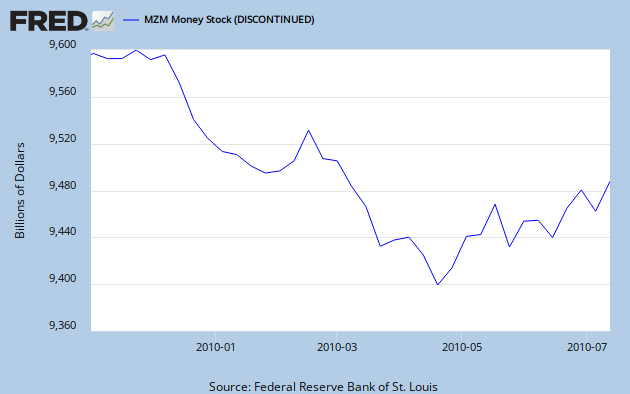
By the way, given the identity M=Bm we can see that technically the Fed has not increased the money supply a lot, it has only increased the monetary base a lot.  In fact, if one looks at MZM or M3 they are actually down for the year.

Update: Matthew Yglesias also responds to Bartlett. 

Ambivalence is Not a Good Sales Pitch

I really wish Paul Krugman would not be so be tepid in his pronouncements of the efficacy of monetary policy.  His recent articles on what monetary policy can do have been less than inspiring and leave great uncertainty in the mind of the reader as to whether the Fed can actually do anything.   Here is a prime example:
The zero lower bound on short rates really does matter...  So it’s not safe to assume that the Fed can, for example, hit any target for nominal GDP that it chooses...The Fed deserves to be chastised for not doing more...
So, on one hand the Fed needs to be doing more, but on the other hand we don't really know whether it will matter.  I am no expert on sales, but I do know a bad sales pitch when I see one and this is one of them.  Wishy-washy calls for more Fed action like the above will not convince anyone, let alone the Fed. Now readers of this blog know that unlike Krugman I do believe the Fed can, for the most part, hit any nominal GDP target that it wants if it so desired.  The reasons for this belief are threefold: (1) Ben Bernanke and other fed officials believe that the Fed could do more; (2) monetary policy was shown to be highly effective in the early-to-mid 1930s, a far worse economic environment than today; and (3) many top economists believe the Fed could do more.  One of these top economists, who happened to win the Nobel Prize for economics, went so far as to argue monetary policy and not fiscal policy is the key to economic  recovery in a depressed economy:
The first-best answer — that is, the answer that economic models, like my old Japan’s trap analysis, suggest would be optimal — would be to credibly commit to higher inflation, so as to reduce real interest rates.
Yes this is Paul Krugman and yes, he is arguing that the first best solution to a depressed economy is more active monetary policy. Now he does go on to note in the same piece that the key here is for the central bank to permanently alter inflationary expectations and doing so may be challenging in practice. Krugman, however, is doing nothing to promote this approach by having columns drenched with ambivalence about the efficacy of monetary policy.  If one wants to sell something one need to convince potential buyers in what they are selling.  Being ambivalent about your product will not do that. 

Friday, July 23, 2010

Bruce Bartlett on What the Fed Can Do

Bruce Bartlett has been discussing what the Fed can do to help stabilize aggregate demand.  In this piece he  joins the growing chorus of observers calling for the Fed to abolish paying interest on banks' excess reserves: 
[M]any economists believe that the Fed has unwittingly encouraged banks to sit on their cash and not lend it by paying interest on reserves. Eliminating interest on reserves would therefore encourage lending. A rumor that the Fed might do so caused the stock market to rise earlier this week, according to press reports. But the policy remains in place.

[...]

To use a hackneyed phrase, the Fed needs to think outside the box and be more innovative and aggressive about getting money to circulate, getting banks to lend, and raising inflationary expectations. Ending payments to banks on money they aren’t lending would be a step in the right direction.
I agree and have been making this same point since October 2008 when the Fed first started this policy. At this juncture, though, the Fed should also add some explicit nominal target--my favorite would be a nominal GDP target--to stabilize nominal expectations and shore up velocity.  As I have said before--and contrary to what Bruce Bartlett claims in his other Fed piece--there is a lot monetary policy can do now to stabilize aggregate demand if it wanted to do so.

The Fed's Balance Sheet: a Problem or an Opportunity?

(Click on figure to enlarge. Source: Cleveland Fed)

Is the Fed's expanded balance sheet a problem or an opportunity? It has grown from approximately $860  billion in early 2007 to about $2.3 trillion today.  That is an increase of over 250%. This enlargement of the Fed's balance sheet implies a corresponding increase in the monetary base.  Obviously, this large of an increase in the monetary base, if multiplied into increases in broader monetary aggregates like M1 or M2, has the potential to fuel spending and become highly inflationary.  But it hasn't happened as most of  the new monetary base is sitting in banks as excess reserves.  It is not being lent out and is far from living up to its reputation as  "high-powered money". Moreover, the market expects this to be the norm for years as inflation expectations across all horizons are falling.  The Fed's balance sheet, then, currently appears to be anything but a problem with regards to inflation.  Now someday it could be a problem, but right now it is not and that indicates the Fed is failing in its efforts to stabilize spending--the one thing the Fed can and should be doing.

Now since the Fed's balance sheet is not  currently a problem it actually has the potential to be useful.  In fact,  it presents a great opportunity to help change inflationary expectations and thus stabilize spending.  How so?  By publicly acknowledging  the inflationary potential of the Fed's expanded balance sheet.   Yes, this seems contrary to what I just wrote above, but that is exactly why it needs to be done.  If enough public officials and other influential observes express concern  about the Fed's balance sheet being inflationary and do it repeatedly then the public will become concerned too.  Inflationary expectations will then increase and  will thus lower current real interest rates, decrease the demand for money (i.e. increase velocity), and improve the outlook for the troubled household balance sheets (by increasing future asset values). 

Now inflationary expectations could overshoot using this approach and there are better ways to stabilize expectations like having the Fed explicitly commit to an inflation, price-level, or nominal GDP target.  But since the Fed seems reluctant to commit to an explicit target this seems like the next best approach.  So talk it up! Sound the alarm! Inflation is coming!