(1) James Hamilton gives us a reality check on the U.S. debt-to-GDP ratio. He shows that we should not take comfort, as some observers do, in comparing the current value of this ratio to what is was coming out of WWII. Back then there was far more non-mandatory spending that could easily be pared down. A very sobering read. [Update: Paul Krugman replies to Hamilton]
(2) David Andolfatto meanwhile is more optimistic on the growing U.S. debt-to-GDP ratio. He cites Ricardo Caballero's argument that there is a shortage of high-quality financial assets in the world and thus the large increase in U.S. Treasuries is actually an optimal outcome. The world needs our Treasuries and the only way we can provide them is to incur more public debt.
(3) Menzie Chinn has a new paper with Jeffry Frieden where they look at the causes and consequences of the current economic crisis. Among other things, they note that the excess savings from the rest of the world was not forced on the United States. Rather, it responded to the excess U.S. demand pressures created by loose fiscal and monetary policies in the United States. They put more emphasis on fiscal policy than I would, but their key point that U.S. economic policies were the important drivers in the buildup of global economic imbalances is spot on.
(4) Tyler Cowen does a Milton Friedman smackdown of David Henderson. Tyler shows, contrary to David's claims, that Milton Friedman thought the Fed in 1929-1931 period should have (1) bought up a lot more bonds (i.e. increased the money supply) and (2) acted a lender of last resort (i.e. done more to prevent the banking system collapse). In short, Milton Friedman was for both stabilizing the money supply and bailing out the banking system. As Tyler notes, the idea of bailouts is hard for many libertarians to swallow, but the alternative may be a far worse outcome for them.
(5) Speaking of running, Justin Wolfers reminds us there is an opportunity cost to this sport. However, he does the calculations and concludes that training for a marathon is an optimal outcome for him.

Macro Musings Blog
Friday, August 28, 2009
Assorted Musings
Some assorted musings:


Wednesday, August 26, 2009
Critically Assessing Bernanke's Record
Now that Bernanke has been renominated to lead U.S. monetary policy his time at the Fed is being critically assessed by a number of observers. Here are five assessments:
(1) Simon Johnson says there are multiple versions of Bernanke--the one that saved the financial system after the Lehman-AIG collapse, the one that intellectually justified Greenspan's low interest rate policy and indifference to asset bubbles, and the one that has pushed for reform of the financial system--and would like to know which one we are going to get in his second term. He also is resigned to the fact that the current Fed policies will most likely lead to another bubble and financial crash.
(2) Stephen Roach highlights three critical mistakes Bernanke made: (i) he saw no need for the Fed to preempt asset bubbles, (ii) he was the intellectual architect of the saving glut view that allowed the Fed to turn the other way when housing boom was taking off, and (iii) he failed to take seriously the need to get a handle on the seriousness of the derivative explosion, the shadow banking system, and the extent of leverage in the U.S. economy.
(3) Ambrose Evans-Pritchard notes that it was Bernanke who provided "academic cover" for (i) Greenspan's view that asset bubbles do not matter and for (ii) holding down interest rates for so long below their neutral level.
(4) Desmond Lachman believes Bernanke's heroic efforts over the past nine months must not overshadow the indifference Bernanke's Fed had toward the housing boom in 2006 and 2007 leading up to the crisis nor his role in the Lehman debacle.
(5) Barry Ritholtz acknowledges that Bernanke's endorsement of Greenspan's interest rate policies were problematic and that his views on asset bubbles and the saving glut gave credence to the Fed's indifference to the housing boom. However, Ritholtz ultimately holds Greenspan accountable for the policies of that time.
Tuesday, August 25, 2009
The Future of U.S. Monetary Policy
Stephen Roach is not pleased with Obama's nomination of Ben Bernanke as the next Fed chair. Despite this outcome, Roach is hopeful that this decision will create a national debate on what should be the objectives U.S. monetary policy going forward:
The Bernanke reappointment is a welcome chance for a broader debate over the conduct and role of US monetary policy. Mr Obama has made sweeping proposals that give the Fed broad new powers in managing systemic risks. I argued in the Financial Times 10 months ago that the Fed should not be granted these powers without greater accountability as required by a “financial stability mandate” – in effect, forcing the Fed to shape monetary policy with an aim towards avoiding asset bubbles and imbalances. Without a revamped policy mandate, it is conceivable that we could face another destabilising crisis.I hate to sound like a broken record, but a nominal income targeting rule would go a long way in improving financial stability.
Is Deflation Still a Threat?
Reuter's Christopher Swann says yes. He explains the nature of the current deflationary pressures and argues they still pose a threat:
One thing I like about Swann is that he takes the time to explain why today's deflationary pressures are harmful--they are driven by a collapse in aggregate demand--and different than the more benign deflationary pressures that occurred earlier in the decade--they were driven by an increase in aggregate supply. This is the view I hold as noted here and here. Finally, note that the fundamental problem here is not deflation per say but a collapse in nominal spending. That is why we need more than ever a nominal income targeting rule.
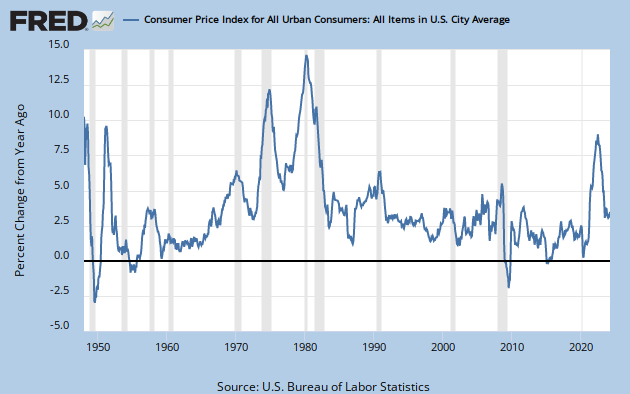
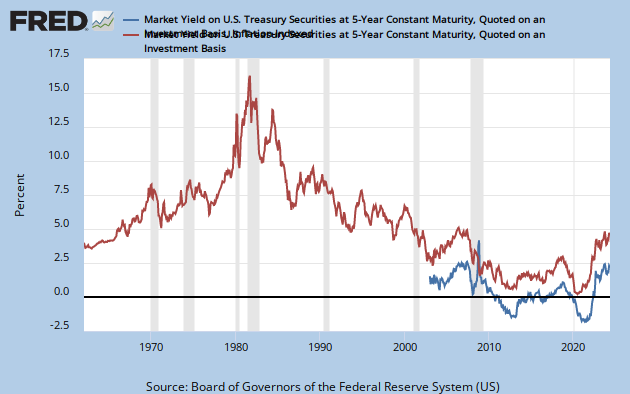
Swann cites research in the piece that core inflation is overstated by 1%. Headline CPI inflation on a year-on-year basis has been negative as can be seen in this graph. TIPs securities, however, show an expected average rate of inflation over the next 5 years that is positive at about 1.3%.The current variety of deflationary pressure... stems not from efficiency savings but rather from weak demand. Worse still, it is accompanied by record levels of debt.
Despite frantic efforts to pay off loans, household debt is still around 130 percent of disposable income. This was precisely the combination that Irving Fisher warned about in his celebrated 1933 article on debt deflation.
Under these conditions, the rising real value of debts encourages households and businesses to sell their assets to pay down loans. As fire sales reduce asset prices — stocks and property — real net worth declines further. Output and employment decline, accelerating the slide in prices.
[...]
So we are right to be afraid of deflation — very afraid. It still has the potential to sap energy from the American economy for years to come.The Federal Reserve is preparing to lay down its unorthodox monetary policy instruments. But it may have to dig deep into its tool box before too long if deflation takes hold.
One thing I like about Swann is that he takes the time to explain why today's deflationary pressures are harmful--they are driven by a collapse in aggregate demand--and different than the more benign deflationary pressures that occurred earlier in the decade--they were driven by an increase in aggregate supply. This is the view I hold as noted here and here. Finally, note that the fundamental problem here is not deflation per say but a collapse in nominal spending. That is why we need more than ever a nominal income targeting rule.
Monday, August 24, 2009
Dark Clouds on the Horizon?
Nouriel Roubini says there may be trouble ahead:
There are also now two reasons why there is a rising risk of a double-dip W-shaped recession. For a start, there are risks associated with exit strategies from the massive monetary and fiscal easing: policymakers are damned if they do and damned if they don’t. If they take large fiscal deficits seriously and raise taxes, cut spending and mop up excess liquidity soon, they would undermine recovery and tip the economy back into stag-deflation (recession and deflation).If that were not enough, Andy Xie shares a similar outlook.
But if they maintain large budget deficits, bond market vigilantes will punish policymakers. Then, inflationary expectations will increase, long-term government bond yields would rise and borrowing rates will go up sharply, leading to stagflation.
Another reason to fear a double-dip recession is that oil, energy and food prices are now rising faster than economic fundamentals warrant, and could be driven higher by excessive liquidity chasing assets and by speculative demand. Last year, oil at $145 a barrel was a tipping point for the global economy, as it created negative terms of trade and a disposable income shock for oil importing economies. The global economy could not withstand another contractionary shock if similar speculation drives oil rapidly towards $100 a barrel.
An Inspiring Picture
This is off topic, but I find this picture inspiring (click on figure to enlarge):

It is a picture of the Antarctica Marathon. Here is a description of the event:

It is a picture of the Antarctica Marathon. Here is a description of the event:
The 11th Antarctica Marathon & Half-Marathon is scheduled for March 7, 2010. You will come face to face with icebergs, penguins, seals and whales while exploring the most pristine corner of the planet. Historians and scientists will provide lectures on board ship and wildlife excursions during landings in remote areas among seal colonies and penguin rookeries and at research bases.I find these exotic marathons alluring and would one day love to do one or more. In addition to the Antarctica Marathon there is the Great Wall Marathon and Mt. Kilimanjaro Marathon, among others. For now I will settle for the Houston Marathon and feel good about warding off lung and gastrointestinal cancer.
Get Ready for Interest Rate Shocks
One of the important messages coming out of the central banker's annual retreat in Jackson Hole, Wyoming is that once the crisis is over the Federal Reserve's (Fed) tightening of monetary policy may be abrupt. If so, increases in short term interest rates will not be gradual but jarring. The reasoning behind this approach, as I understand it, is that (1) since there could be political pressures to monetize the government debt and (2) given the large amount of existing liquidity that needs to be drained the Fed's exit strategy needs to be unmistakably clear in communicating that it will not tolerate the unanchoring of inflationary expectations. Here is the New York Times:
A growing number of economists and some Fed officials say the shift to tighter monetary policies and higher interest rates, though unlikely to start until at least the middle of next year, may have to be much more abrupt than normal if they are to prevent inflation two or three years from now.And here is the Wall Street Journal on the talk Carl Walsh gave at the retreat:
“When you get into a crisis like this, gradualism is not the right strategy,” said Frederic S. Mishkin, an economist at Columbia University who was a Fed governor from 2006 until 2008. “Of course, when things turn around, you have to be aggressive in the other direction.”
[O]nce the Fed does start raising the federal-funds rate out of its current record-low range near zero, "it should be increased quickly," Mr. Walsh argued. "There is no support for raising rates at a gradual pace once the zero rate policy is ended."This rhetoric is sounding so Paul Volker-like. It remains to be seen, though, whether the Fed could actually make such abrupt changes in monetary policy. There are two major obstacles to such an approach. First, now that the global economy has become addicted to a low interest rate policy, any drastic tightening will amount to a painful interest rate shock. Second, tightening policy may make the budget deficits even larger and make it more costly to finance, a point alluded to in the New York Times article:
Indeed, the Federal Reserve’s “exit strategy” could lead to a clash with the Obama administration. The White House plans to release its newest budget estimates next week, and administration officials said that the 10-year deficit will rise to $9 trillion — a big jump from its earlier estimate of $7 trillion.
[...]
In the future, Fed officials could feel more pressure to further tighten monetary policy as a way of countering the government’s deficit spending. The immense amount of borrowing could push up long-term interest rates, if foreign investors balk at buying up United States debt.
Of course, all of this analysis assumes the Fed knows when the time is right to begin its exit strategy. As noted in my previous post, however, even this assumption is questionable. Fed policy over the next few years should be a doozy to watch.
Subscribe to:
Posts (Atom)