Pages

Showing posts with label Malign vs Benign Deflation. Show all posts

Tuesday, August 25, 2009

Is Deflation Still a Threat?

Reuter's Christopher Swann says yes. He explains the nature of the current deflationary pressures and argues they still pose a threat:

The current variety of deflationary pressure... stems not from efficiency savings but rather from weak demand. Worse still, it is accompanied by record levels of debt.

Despite frantic efforts to pay off loans, household debt is still around 130 percent of disposable income. This was precisely the combination that Irving Fisher warned about in his celebrated 1933 article on debt deflation.

Under these conditions, the rising real value of debts encourages households and businesses to sell their assets to pay down loans. As fire sales reduce asset prices — stocks and property — real net worth declines further. Output and employment decline, accelerating the slide in prices.

[...]

So we are right to be afraid of deflation — very afraid. It still has the potential to sap energy from the American economy for years to come.

The Federal Reserve is preparing to lay down its unorthodox monetary policy instruments. But it may have to dig deep into its tool box before too long if deflation takes hold.

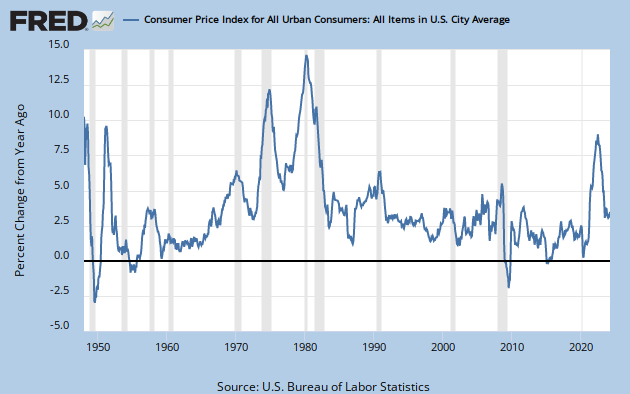
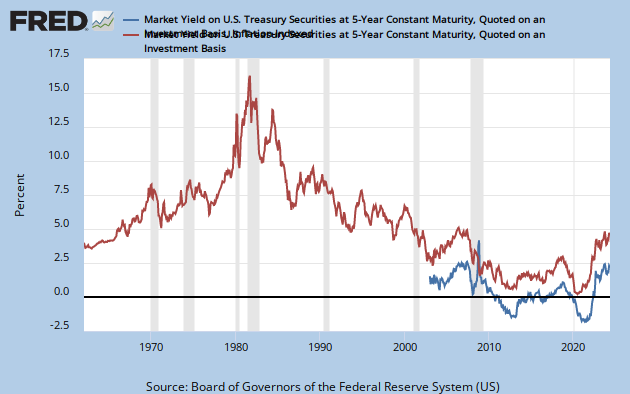
Swann cites research in the piece that core inflation is overstated by 1%. Headline CPI inflation on a year-on-year basis has been negative as can be seen in this graph. TIPs securities, however, show an expected average rate of inflation over the next 5 years that is positive at about 1.3%.

One thing I like about Swann is that he takes the time to explain why today's deflationary pressures are harmful--they are driven by a collapse in aggregate demand--and different than the more benign deflationary pressures that occurred earlier in the decade--they were driven by an increase in aggregate supply. This is the view I hold as noted here and here. Finally, note that the fundamental problem here is not deflation per say but a collapse in nominal spending. That is why we need more than ever a nominal income targeting rule.

Monday, June 22, 2009

The Deflation Threat of 2009 vs. The Deflation Threat of 2003

Over the weekend, Alan Blinder in the New York Times and Ambrose Evans-Pritchard in the Telegraph both noted that that the real threat currently facing the U.S. economy is not inflation but deflation. One only needs to look at the large negative output gap, the dramatic collapse in nominal spending, or the declines in velocity and the money multiplier to see that there is merit to their claims. There is a real deflationary threat lingering over the U.S. economy in 2009.

With that said, there is an unfortunate irony to the current deflationary threat that can be traced back to 2003. Back then there was another deflationary threat that concerned the Federal Reserve (Fed). As a result, the Fed lowered the federal funds rate to what was at the time an historically low value of 1%. It held this short-term interest rate there for a year before gradually tightening. As we now know, this excessively-loose monetary policy was an important contributor to the buildup of the economic imbalances that eventually led to this economic crisis, including the current deflationary threat. In short, the fear of deflation in 2003 laid seeds for the deflationary threat of 2009.

What makes this an unfortunate irony is that this chain of events did not have to happen. For there was a big difference between the deflationary pressures in 2003 and the ones in 2009. In 2003 the deflationary pressures were driven by rapid productivity gains and were benign in nature. Moreover, nominal spending or aggregate demand was rapidly growing. There simply was no evidence of a malign deflationary threat as there is today and thus, there was no need for the Fed to drop interest rates so low for so long. I have documented these developments in previous posts, but here are a few key graphs that make the case. First, here is the year-on-year productivity growth rate plotted against the ex-post real federal funds rate (click on figure to enlarge):


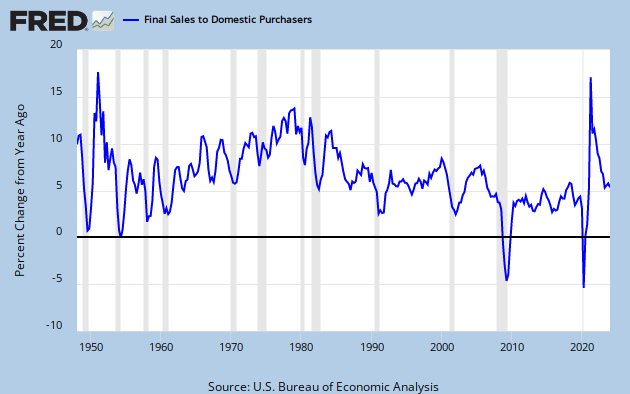
This pictures shows that Fed was pushing the real federal funds rate into negative territory just as productivity was increasing. The next figure shows final sales to domestic purchasers, a measure of nominal spending in the United States plotted against the federal funds rate. The year 2003 is marked off by the dotted lines (click on figure to enlarge):


No indication here of a collapse in nominal spending in 2003. (There was the weak labor market in 2003, but as I have argued before the slow recovery of employment can most likely be traced to (1) the robust productivity gains and (2) the inordinate substitution of capital for labor given the low interest rates of the time.) What this all means is that the Fed's misreading of the deflationary pressures in 2003 contributed to the creation of deflationary pressures of 2009.

My hope is is that moving forward the Fed and other monetary authorities will be more careful in assessing the sources of and responding to the deflationary pressures.

Monday, May 18, 2009

Understanding Recent Economic History

The Economist magazine has an article on what it sees as the beginning of a new global economic order. In the article, the history of international monetary systems up through the present economic crisis is reviewed. Here is an excerpt from this history that I particularly liked:
The post-Bretton Woods system worked well, engendering the long period of low inflation and steady growth known as the Great Moderation. But one of the reasons for its apparent success—the growth of India and China—may have sparked its demise. The addition of these two great nations to the international financial system was a supply shock that put downward pressure on inflation rates.

As Stephen King, an economist at HSBC, has pointed out, the result might have been a benign deflation that boosted Western living standards. But central banks struggled to avoid a deflationary outcome; the result was a loose monetary policy that encouraged asset bubbles. Those bubbles lasted longer than expected because the flood of savings from developing markets held down the risk-free rate.
This is spot-on analysis by The Economist. I make a similar argument in this recent article in the Cato Journal.

Monday, February 9, 2009

No, Greenspan Was Not Right

Nick Rowe asks an interesting question:
In 2003, Alan Greenspan argued that the Fed needed to set low interest rates to prevent falling into a liquidity trap and deflationary spiral... In 2008, Greenspan's critics argue that those same low interest rates caused an asset bubble, which burst, causing the economy to fall into a liquidity trap and deflationary spiral. Is it possible that Greenspan and his critics were both right? Was the US economy doomed either way?
My answer is no. A deflationary spiral of the kind Nick describes is the result of a collapse in aggregate demand that creates expectations of further declines in nominal spending and ultimately the price level. Along the way the policy interest rate hits its lower bound of zero, real debt burdens increase, and financial intermediation gets disrupted. These conditions better describes today than 2003. The deflation scare of that time was simply a panicked misreading of deflationary pressures arising from robust productivity gains. To make my case I have re-posted with some editing portions of a previous post:
These next three figures make my case. The first figure shows productivity--as measured by non-farm business labor productivity--did see an acceleration in its year-on-year (Y/Y) growth rate around 2003:


The figure also shows the ex-post real federal funds rate (ffr) relative to the Y/Y productivity growth rate. Assuming there were no significant changes in intertemporal preferences and population growth rates, this first figure suggests the Fed was pushing its policy rate down as the natural rate--which is a function of intertemporal preferences, population growth rate, and productivity growth rate--was increasing.

The next figure shows the Y/Y growth rate of nominal spending--measured by final nominal sales to domestic purchasers--against the nominal ffr. The year in question, 2003, is highlighted by the two dashed lines. This figure indicates nominal spending or aggregate demand was not collapsing but rather growing throughout 2003. The ffr, on the other hand was being pushed to down to 1%.


So productivity was increasing and aggregate demand was not collapsing. What about the weak labor market? One story is that the "jobless recovery" was simply the consequence of the above productivity gains. Another story is that the existing low ffr was pushing the cost of capital down and encouraging an inordinate substitution of capital for labor by 2003. In either case, there is no justification for further lowering of the ffr in 2003. The figure below sheds some light on this view. It graphs real non-residential fixed investment against total nonfarm employment with the year 2003 again delineated.


This figure shows that non-residential fixed investment was recovering in 2003 while employment remained flat. Firms, therefore, were investing in their capital stock while avoiding new additions to labor. I suspect monetary policy played some role in this development.
So Greenspan may have thought a deflationary spiral was around the corner in 2003, but the data indicates there was none in sight.

Sunday, February 1, 2009

Samuel Brittan on Deflation

Samuel Brittan writes in the Financial Times:
Too much that passes for financial comment is preoccupied with the bogey of deflation when it ought to be concerned with the reality of slump.
If I read Brittan correctly, he is saying we should focus on the source of the problem--the slump--not the symptom of it. Sounds like Brittan would be sympathetic to a nominal income target for monetary policy. Brittan also makes this interesting comment:
Some of the same short-fused commentators who now blame Alan Greenspan, the former Federal Reserve chairman, for overstimulating the US economy [in the early-to-mid 2000s] were then screaming for him to do more to offset the threat of deflation.
Brittan goes on to talk more about deflation, including the mention of an article I really enjoyed reading.

Friday, January 16, 2009

The Failure of Deflation Orthodoxy

As readers of this blog know, I am someone who believes that the loose U.S. monetary policy of 2003-2005 was an important contributor--though not the only one--to the buildup of economic imbalances that are the source of the current economic crisis. I have also argued that a key a reason for the highly accommodative monetary policy was that the Fed, following the conventional wisdom on deflation, viewed the deflationary pressures at the time as a sign of weakened aggregate demand and acted to offset it. Though well intended, the Fed's response was highly distortionary since the deflationary pressures turned out to be driven by rapid productivity gains rather than weakened aggregate demand. The Fed, therefore, was adding significant stimulus to the economy at the same time it was being buffeted by rapid productivity gains, a surefire way to push the U.S. economy past its speed limit. What all this means is that had the Fed been better able to distinguish between malign and benign deflationary pressures some, maybe much, of the economic imbalance buildup could have been avoided. This is an important lesson from this economic crisis. It is also one that I more fully discuss in a recently published article that can be found here.

Update: In addition to my article cited above, other recent papers making a similar case include William White's article "Is Price Stability Enough?" and this interesting article by The Economist magazine.

Thursday, August 14, 2008

Benign Deflation in a New Keynesian Model

As readers of this blog know, I am a advocate of monetary policy adopting a more nuanced view of deflation. Currently, most observers view any deflationary pressures as something to be avoided at all costs. This conventional wisdom assumes all downward price level pressures are economically harmful and, thus, fails to distinguish between between aggregate demand-induced deflationary pressures and aggregate supply-induced deflationary pressures. As a result, central bankers are likely to add monetary stimulus during periods of rapid economic growth--for example, when a positive productivity shock increases aggregate supply--in the mistaken belief that the deflationary pressures indicate economic weakness. Such actions, in turn, can generate a boom-bust cycle in economic activity. As I have argued elsewhere (here, here, here), the Fed's easy money in 2003-2005 in one such example.

Given these views of mine, I was pleased to come across Niloufar Entekhabi's new article, "Technical Change, Wage and Price Dispersion, and the Optimal Rate of Inflation." In it, Entekhabi uses a standard New Keynesian model to find the optimal rate of inflation and it turns out to be negative. One innovation of the paper is that it incorporate non-zero long-run growth in the model. From his conclusion:
This paper shows that adding real growth to the New Keynesian models is a very important feature, missing from the studies of these models. Real growth brings the arguments of price deflation rate as an optimal policy back to the policy discussion. In this research, real growth is added to a simple New Keynesian model with both price and wage rigidities. In such an environment, the economy faces four types of distortions, due to the imperfect nature of markets and the staggered contracts. Then, the Pareto optimal level of output is no longer attainable. The optimal policy is considered as the optimal rate of inflation which the central bank should target to minimize the distortions in the economy. In our experiment and under a wide range of parameter values and calibrations, this rate reveals to be slightly negative and therefore, deflation is the optimal policy... The results favor the old view in the monetary policy literature that a slight level of deflation is optimal. These results are very useful for policy analysis and show the path for the future research.
I had been meaning to do something like this paper after the reading the other New Keynesian-type analysis that also finds benign deflation might be optimal. This other paper, though, finds benign deflation to be optimal in the terms of minimizing asset boom-bust cycles. In case you missed it, here is part of my post on that research:
Lawrence Christiano, Roberto Motto, and Massimo Rostagno have a new NBER working paper titled "Two Reasons Why Money and Credit May be Useful in Monetary Policy." I find this article interesting because one of the reasons the authors cite for taking money and credit seriously in monetary policy--as opposed to standard New Keynesian analysis that sees little role for money--is that focusing "narrowly on inflation [alone] may inadvertently contribute to welfare-reducing boom-bust cycles in real and financial variables." The authors show that if (1) there are positive productivity innovations and (2) monetary policy follows a standard Taylor rule that responds to deviations of inflation from its target then boom bust cycles in asset prices can be generated.

The authors explain that in "the equilibrium with the Taylor rule, the real wage falls, while efficiency dictates that it rise [following a productivity shock]. In effect, in the Taylor rule equilibrium the markets receive a signal that the cost of labor is low, and this is part of the reason that the economy expands so strongly. The ‘correct’ signal would be sent by a high real wage, and this could be accomplished by allowing the price level to fall. However, in the monetary policy regime governed by our Taylor rule this fall in the price level is not permitted to occur: any threatened fall in the price level is met by a proactive expansion in monetary policy."

In other words, these authors are arguing that by not allowing for benign deflation--deflation generated by productivity innovations--monetary authorities are generating too much liquidity and, in turn, fueling asset price boom-bust cycles.
I hope to see many more papers like these ones on the macroeconomic implications of benign deflation. I have a few related projects in the pipeline and I believe Josh Hendrickson does as well. Maybe George Selgin and the folks at the BIS--see William White's classic "Is Price Stability Enough?"--can also push some more papers out on this topic.

Friday, May 23, 2008

The Conventinonal Wisdom on Deflation

The Conventional wisdom on deflation is that it is economically harmful and should be avoided at all costs. Consequently, no central bank explicitly targets deflation and few observers would dare say anything nice about deflation. The origins of this deflation orthodoxy can be traced to the painful deflation experience during the Great Depression of the 1930s. Japan's experience with deflation and its weak economy in the 1990s only reinforced this view. The modern economic psyche, therefore, has been programmed to go into fits at the first sign of any deflationary pressures.

This aversion to deflation can seen in the figure below that shows the number of articles on U.S. deflation in major world newspapers and the U.S. inflation rate for the years 1992-2004. During this time there were two deflation scares--one 1998 and the other in 2003--when the inflation rate dropped below 2%. As you can see the number of deflation articles spiked around these deflation scares, with most of the articles expressing anxiety over deflation. [Click on graph to enlarge.]

[The number of deflation articles comes from Lexus-Nexus search with the keywords “deflation” and "United States" or "U.S." Included in the search was a string of words and word roots associated with deflation’s potentially harmful and adverse consequences (e.g. zero nominal interest rate bound, debt burden, liquidity trap, economic weakness). I assume that any article having these key words is expressing at some level anxiety or concern over deflation.]

As some of you know, I have a problem with this deflation orthodoxy because it fails to distinguish between deflationary pressures arising from a negative aggregate demand shock versus that arising from a positive aggregate supply shock. As the above figure indicates, almost everyone assumed the deflationary pressures in 1998 and 2003 were harmful when in fact the data suggests that much of it was the result of the rapid productivity growth in those two years. This deflation orthodoxy explains why the Fed lowered its policy rate to historic lows: it, like most everyone else, thought the deflation of 2003 was of the harmful form. Because of the deflation orthodoxy, then, the Fed pushed the real federal funds rate to historic lows at the very time the rapid productivity growth was suggesting a higher natural interest rate. As I have argued elsewhere, this set off a credit and housing boom-bust cycle that we are now trying to sort out.

I hope going forward that conventional wisdom of deflation will emerge to a more nuanced view that distinguishes between the harmful aggregated demand-induced deflation and the more benign aggregate supply-induced deflation.

Wednesday, May 14, 2008

How the Fed Can Minimize Asset Bubbles

The Financial Times (FT) is reporting that the Federal Reserve is looking for new ways to fight the assets bubbles of the future. In addition to better prudential regulation, the Fed is even considering--gasp--using its policy rate to nip an asset bubble in the bud. If you have been following the debate of asset bubbles at the Fed you will know this is a radical departure from past thinking. In the words of the FT:
The US Federal Reserve is reconsidering the way it deals with asset price bubbles in the wake of the housing and credit bust, in a move that could see the central bank using regulation – or even interest rates – to fight unjustified increases.

[...]

One option would be for the Fed to tackle bubbles with monetary policy, setting interest rates higher than they would otherwise be when asset prices appear to be inflating beyond levels justified by economic fundamentals.

Mr Bernanke rejected this approach in 2002 but is willing to re-evaluate it in the light of recent events.
Better prudential regulation and a willingness to take into consideration the possibility of asset bubbles in the conduct of monetary policy is progress. The tricky part, though, is how to modify monetary policy so that is responds in a systematic way to asset bubbles. One approach would be to simply add asset prices to a Taylor rule. However, even in a forward-looking Taylor rule with asset prices, monetary policy would only be responding to an asset bubble after it had emerged, after the asset bubble horse is already out of the barn. (This is because asset bubbles--which by definition are not based on fundamentals--cannot be predicted.) Would it not better to have a rule that minimized the emergence of asset bubbles in the first place?

I believe a nominal income targeting rule is just such a rule. In fact, for some time I have argued here that monetary authorities may actually increase macroeconomic volatility by aiming to stabilize some form the price level (e.g. inflation targeting), rather than nominal income. My reasoning has been that changes in aggregate productivity that are offset by monetary authorities, so as to maintain price level stability, can lead to economic imbalances. For example, in this post I said the following:
Imagine the U.S. economy is buffeted with a series of positive productivity shocks that increases aggregate supply. This development would put downward pressure on the price level and set off the deflation red alert sign at the Federal Reserve. Now, in order to keep the price level from falling, the Federal Reserve must act to increase nominal spending. If this change in monetary policy were unexpected, or if there were significant nominal rigidities (i.e upward sloping Short-run aggregate supply curve), the nominal spending increase that stabilizes the price level would also push actual output beyond its natural rate level. Hence, there would be both a sustainable component—the productivity gains—and a non-sustainable component—the monetary stimulus—to the subsequent increase in real output. Moreover, the unsustainable pickup in actual output would occur without any alarming increases in the price level ... The increase in nominal spending could thus create a boom-bust cycle in real economic activity without any of the standard inflationary signs of overheating.
In this scenario, had monetary authorities stabilized nominal spending--allowed the price level to fall while output increased--there would have been no positive output gap. Consequently, it would have been better for monetary authorities to stabilize nominal spending through a nominal income targeting rule. Note, that this understanding would also have implications for interest rates:
These developments could also be viewed from an interest rate perspective. Here, the Wicksellian view that the actual real rate of interest can deviate from the natural rate of interest in the short run is invoked. The natural rate of interest is the real interest rate justified by non-monetary fundamentals, specifically the productivity of capital, the labor supply, and individuals’ time preferences and is the real interest rate consistent with the natural rate level of output. Recall that an increase in the growth rate of productivity should be matched by a similar increase in the natural rate of interest. If, however, monetary authorities attempt to offset the productivity-generated deflationary pressures by lowering the policy interest rate, they may force the actual real interest rate below the natural interest rate. This response can create an unsustainable credit boom. The resulting macroeconomic disequilibrium will be manifested in unwarranted capital accumulation, excessive leverage, speculative investments, and inordinate asset prices...
Here again, in this scenario--which sound eerily familiar to the U.S. economy during 2003-2005--had monetary authorities instead stabilized nominal spending the real rate of interest would not have fallen below the natural rate of interest. To the extent a nominal income monetary policy rule prevents an asset bubble from emerging in the first place, it would be better than a Taylor rule that responds after the asset bubble formed. So how about it Chairman Bernanke and other member of the Fed: what do you think about a nominal income targeting rule as means to minimizing asset bubbles?

Update: Take a look at this nominal income targeting rule.

Wednesday, March 19, 2008

Tyler Cowen on Deflation

While grading papers yesterday, I listened to Tyler Cowen's EconTalk on monetary policy with Russ Roberts. Listening to Tyler's calm, soothing voice as he discussed all things monetary made the frustrations of grading all the more bearable. The discussion is definitely worth your time.

Amidst the Cowen-induced calm, however, I did have a momentary lapse into the land of angst when the topic of deflation was brought up. Roberts asked Cowen what would happened if the monetary base were frozen in a growing economy. Cowen correctly replied that there would emerge deflationary pressures. He then proceeded to say, though, that such a development would be a destabilizing outcome since people are not capable of handling a world of falling prices. Owing to "human irrationality", Cowen claimed worker morale would suffer if laborers got a 3% nominal wage cut even if the price level fell 4% in an expanding economy. Moreover, maintaining inflationary expectations among workers provides an "easy way to trick people into a wage cut" if needed.

Wow--is this really Tyler Cowen or his evil twin Tyrone Cowen? I certainly did not expect this response from Tyler. Let me begin my reply to whichever Cowen it may be by stating up front I do not advocate a freezing of the monetary base (although something like that happened after the U.S. Civil War). I am, though, open to a monetary policy rule that allows for productivity changes to be more fully reflected in the price level--George Selgin's Productivity Norm rule comes to mind--because doing so may actually improve macroeconomic stability (see here). Such an approach to monetary policy would also imply mild deflation at times, so Cowen's critiques still apply and must be examined.

So, Cowen believes people are subject to a form of money illusion that only allows them to be fully functional when prices are rising. In short, people are too dumb to distinguish between nominal and real values. This understanding is surprising for someone who champions a more libertarian view of the world, one where individuals are capable of making choices--such a distinguishing between nominal and real values--that improve their welfare. Empirical evidence suggests Cowen should take more seriously his libertarian instincts on this issue. Michael Bordo and Andrew Filardo in their article "Deflation in Historical Perspective" review the literature on this topic and conclude

... that such notions of downward wage inflexibility that were formed during the Great Inflation may in fact be regime-dependent. It is possible that once a low inflation or moderate deflation environment were to become more familiar, the past psychological aversion to downward nominal, rather than real, movements would become less of a constraint.


Even stronger evidence for regime-dependent framing of expectations comes from Christopher Hanes and John A. James in their AER article, "Wage Adjustment under Low Inflation: Evidence from U.S. History" From their conclusion:

We have looked for evidence of downward nominal wage rigidity in the nineteenth-century United States, using data that allow clear comparisons between historical and modem patterns. We find no evidence of downward nominal wage rigidity in the historical data, especially when they include the various monetary regimes of the 1860's and 1870's. One interpretation consistent with our results would be that the modern wage floor reflects employers' fear of damaging employee "morale" by violating social norms and concepts of fairness (as described by Bewley, 1999) rather than a fundamental preference on the part of workers. Unlike fundamental preferences, social norms can change with the economic environment. Under monetary regimes delivering very low trend inflation, such as the postbellurn deflation, a norm that enforced downward nominal wage rigidity could become costly for individual employers and employees, as well as for society as a whole… It seems safe to conclude… that U.S. historical experience fails to support the proposition that downward nominal wage rigidity is a fundamental feature of employment that prevails under any circumstances.


Cowen's view, then, of downward nominal wage rigidity is more representative of the inflationary times in which we live than a universal truth.

As I mentioned above, there are also reasons related to macroeconomic stability that should make Cowen more open to deflation, at least the benign form. That is why I like George Selgin's Productivity Norm rule. (In case you missed it, here are my postings on the relationship between macroeconomic stability and benign deflation.) From what I can tell, Cowen's colleague Bryan Caplan takes this latter point more seriously. Sometime they should get together and discuss George Selgin's "Less than Zero".

Update: G. Selgin makes an excellent point in the comments section--there is no need for a downward wage adjustment under the productivity norm. The decline in the price level will guarantee a rise in the real wage. Thus, the issue of whether wages are downwardly mobile is really inconsequential with productivity norm.

Sunday, February 17, 2008

Lessons Learned from the Greenspan Era

The Financial Times has an editorial comment looking at the lessons learned from the Greenspan era. I have posted the piece below with my comments in brackets.

Learning from the Greenspan Legacy

The subprime crisis is Alan Greenspan’s fault, or so we are increasingly told: he offered bankers too much monetary candy and should have put them on a monetary diet instead. Is this criticism justified? And what does it imply for the future behaviour of central banks?

Few now have as much confidence in the self-restraint of the financial children as Mr Greenspan was wont to. No less certainly, Mr Greenspan’s reputation is sinking. Once hailed as a maestro, he is condemned by many as profligate. The truth is more complex. He was never the genius he was held to be. Nor is he the dunce some now allege. He was merely fallible. As such, he made good and bad calls.

Four features of the global economy – low inflation, the global “savings glut”, globalisation and the US productivity upsurge – have made managing monetary policy seductively difficult. It was difficult because the combination of low interest rates with fast economic growth proved the breeding ground for a succession of asset bubbles, most recently in housing. It was seductive because the bubbles were so popular, at least at the time.

[I concur--rapid real economic growth fueled by productivity gains and accompanied by historically low real interest rates is a Wicksellian no-no. The Fed cannot push the actual real interest rate below the neutral one and expect all will be well. Below is a graph from an earlier post that illustrates these developments (see here for larger picture).]

Even if one grants the difficulty, the US Federal Reserve might have erred: its monetary policy might have been too loose after 2000, particularly when its target interest rate sank to 1 per cent in 2003; it might also have remained loose for too long; it might have been asymmetric, with more attention being paid to downside than upside risks; and it might have paid too little attention to asset prices. Furthermore, under Mr Greenspan, the Fed might have assumed too readily that the financial system was self-policing.

Of these charges, the first is least plausible. After the stock market bubble burst, the case for insurance against deflation was overwhelming. But the argument that policy was loose for rather too long looks convincing, in hindsight. The asymmetric response to asset price movements is also, alas, compelling: in practice, the Fed has responded to asset price declines with greater urgency than to rises.

[Regarding the first charge, the case against deflation was not overwhelming. As suggested by the above figure and as I have made clear elsewhere, there is enough evidence to doubt the deflationary pressures of 2003 were of a malign nature. Rather, it is more reasonable to conclude they were the product of rapid productivity gains. I will concede the evidence is mixed for 2002, but by 2003 the deflationary pressures appear to have been largely benign. The Fed simply misread the deflationary tea leaves in 2003 and thus set a monetary policy in play that was distortionary. A few observers recognized this possibility of misreading the deflatoinary pressures back then and the potential consequences that could follow. Others are now vindicating this view.]

Yet the last charges seem the most important. The Fed’s view is that central bankers should respond to asset price bubbles only after they burst. But the bursting of a bubble associated with a credit surge is almost always highly destabilising. Taking at least some preventive action surely makes sense. Finally, the view that financial markets are self-policing is, alas, rather less credible than it was. A year can be a long time in economic policy.

[George Selgin has suggested a monetary policy rule that would address some of these problems. It is a nominal income targeting rule that would allow productivity movements to be more readily reflected in the price level. Selgin calls this the 'Productivity Norm' rule. See here for more about this rule or check out his book "Less than Zero."]

So central bankers have to learn lessons. Yes, the bankers were responsible for bingeing on the cheap money provided. But central banks bear responsibility for providing the feast and need to be more frugal in future. So Ben Bernanke, the Fed chairman, should take note. Using a new supply of candy to cure indigestion might cause even sharper pains tomorrow.

Wednesday, February 13, 2008

There is a New Business Cycle on the Loose...

according to Thomas Polley and Paul Krugman. Thomas tells us that a new business cycle emerged in the 1980s and is defined by "large trade deficits, manufacturing job loss, asset price inflation, rising debt-to-income ratios, and detachment of wages from productivity growth." He also notes that the new business cycle "embeds a monetary policy that... tacitly puts a floor under asset prices." Paul takes a slightly different look at this new business cycle by focusing on its expansionary and contractionary stages. He notes that unlike pre-1983 recessions, the contractionary stage--which he calls a "postmodern recession"--is now more endogenous in nature and occurs as a result of the natural unwinding of economic imbalances. Simply put, these recessions are not being engineered by the Federal Reserve. Paul also notes that while these postmodern recessions are less painful than before, they seem to be more protracted.

I think Thomas and Paul are definitely on to something. However, rather than calling it a new business cycle, I would say it is the same business cycle responding to developments that were not around prior to the 1980s. These developments are (1) widespread financial liberalization, (2) credible anti-inflation regimes, and (e) globalization of the real economy. Claudio Borio and his colleagues at the Bank for International Settlements (BIS) have been writing about these developments for some time. A key message they have been consistently making is that monetary policy and prudential policy as usual are not going to cut it in this new era.

In their "Whither Monetary and Financial Stability? The Implications of Evolving Policy Regimes", Claudio Borio and William White summarize the nature of this new era:

Like a good novel, each phase in economic history has its villains, heroes and defining moments. Often, it is only with hindsight that we can identify them. There is little doubt now that the great villain during much of the postwar period has been inflation… The defining moment, perhaps, was the end of the 1970s, when monetary policy in the leading economy of the globe, the United States, purposefully sought to break the enemy’s back, thereby fostering a more favourable environment for similar battles elsewhere.

At the same time, since the 1980s a new concern, financial instability, has risen to the top of national and international policy agendas. It is as if one villain had gradually left the stage only to be replaced by another… Why has the full “peace dividend” of the war against inflation ostensibly failed to materialise?


Although the above paper answers this question, for the sake of variety I take you now to Claudio's article with Ilhyock Shim titled "What Can (Macro-)prudential Policy do to Support Monetary Policy?" to get answers and perspective on this question:

[These new] dynamics of the world economy [can be traced] back to the triad of forces mentioned at the outset[:] financial liberalisation, the establishment of credible anti-inflation regimes and the globalisation of the real-side of the economy...

Financial liberalisation may have made it more likely that financial factors in general, and booms and busts in credit and asset prices in particular, act as drivers of economic fluctuations. In particular, financial liberalisation has greatly facilitated the access to credit. It has therefore also increased the scope for perceptions of wealth and risk to drive the economy, more easily supported by external funding. More than just metaphorically, we have shifted from a cash-flow constrained to an asset-backed global economy. Such perceptions are highly procyclical, reinforcing expansions and contractions as they move in sync with the real economy. While these forces are essentially part of the “physiology” of the economic system – the oil that lubricates it – occasionally, they may go too far, and hence become part of its “pathology”...

At the same time, the establishment of a regime yielding low and stable inflation, underpinned by central bank credibility, may have made it less likely that signs of unsustainable economic expansion show up first in rising inflation and more likely that they emerge first as excessive increases in credit and asset prices (the “paradox of credibility”).

Finally, the globalisation of the real economy may have played a dual role. On the one hand, it may have represented a sequence of pervasive positive supply-side “shocks”. Such shocks would tend to raise world growth potential and help to keep inflation down while at the same time encouraging the asset price booms on the back of liquidity expansion…As history indicates, such supply-side-driven deflations are quite benign compared with their demand-driven counterparts. The risk is that, paradoxically, excessive resistance to “good deflations” can, over time, lead to “bad deflations”, if it supports the build-up of financial imbalances that eventually unwind.
[i.e. a point that I have repeatedly made on this blog... see here]

Finally, I send you to Claudio's piece with Philip Lowe titled "Asset Prices, Financial and Monetary Stability: Exploring the Nexus" for further insights:

Economic historians will no doubt look back on the last twenty years of the 20th century as those that marked the end of a long inflationary phase in the world economy.... And yet, the same decades will in all probability also be remembered as those that saw the emergence of financial instability as a major policy concern, forcing its way to the top of the international agenda. One battlefront had opened up just as another was victoriously being closed. Ostensibly, lower inflation had not by itself yielded the hoped-for peace dividend of a more stable financial environment...

We would like to make three points.

First, posing the question in terms of the desirability of a monetary response to "bubbles" per se is not the most helpful approach. Widespread financial distress typically arises from the unwinding of financial imbalances that build up disguised by benign economic conditions. Booms and busts in asset prices... are just one of a richer set of symptoms...

Second, while not disputing the fact that low and stable inflation promotes financial stability, we stress that financial imbalances can and do build up in periods of disinflation or in a low inflation environment. One reason is the common positive association between favourable supply-side developments, which put downward pressure on prices, on the one hand, and asset prices booms, easier access to external finance and optimistic assessments of risk, on the other

Third, achieving monetary and financial stability requires that appropriate anchors be put in place in both spheres. In a fiat standard, the only constraint in the monetary sphere on the expansion of credit and external finance is the policy rule of the monetary authorities. The process cannot be anchored unless the rule responds, directly or indirectly, to the build up of financial imbalances. In principle, safeguards in the financial sphere, in the form of prudential regulation and supervision, might be sufficient to prevent financial distress. In practice, however, they may be less than fully satisfactory...


I hope influential observers like Thomas Polley Paul Krugman as well as policymakers take note of this work coming out of the BIS.

Thursday, January 24, 2008

The Economist and Benign Deflation

I had the privilege today of meeting Zanny Minton Beddoes, the economics editor for The Economist magazine. She was a presenter at at a regional economic outlook conference held in nearby Austin, Texas. Her part of the program was to deliver an assessment of the national economy. She did a great job describing the major shocks that have recently hit the U.S. economy--high oil prices, frozen credit markets, housing market bust--and the potential outcomes of these shocks. After her talk, I was able to chat with her for a few minutes. Among other things, I complemented her and The Economist for taking seriously the implications of benign deflation for the U.S. economy during the 2003-2005 period. As I have argued before, the Fed's misreading of the 2003 deflationary pressures as being malign when in fact they were benign led to an overly accommodative monetary policy at that time. As a consequence, interest rates were pushed far beneath their neutral level and the stage was set for the biggest housing boom-bust cycle in U.S. history. The Economist recognized this was happening and was one of the few observers sounding the alarm over this development (Andy Xie was another, see here). Only now are other observers (here, here) beginning to see how prescient The Economist was in its calls to reign in monetary policy during this time. It was a real treat, then, for me to meet Zanny, and briefly discuss these issues with her.

In case you missed The Economist's coverage of benign deflation and its implications for the U.S. economy during the 2003-2004 period, I have posted below an edited version of an article that appeared in 2004.

From The Economist print edition

A new paper questions whether inflation will really turn out to be America's main economic problem... Most commentators have cheered Alan Greenspan and his colleagues at the Fed for being so aggressive in warding off the deflationary threat caused by huge corporate debts and the popping of the stockmarket bubble... Mr King is not among those cheerleaders. He argues that the Fed was wrong to cut interest rates so much, because much of the deflationary pressure was of an altogether more benign sort: a reduction in overall prices caused by rapid technological change, improvements in the terms of trade and other factors. Britain had long periods of “good” deflation in the late 18th and 19th centuries, when nominal interest rates and growth were both strong. In recent years, argues Mr King, there has again been deflation of just that sort, and for similar reasons. Technological change and the integration of China, and increasingly India, into the global economy have pushed down the price of traded goods in America, thus pushing up real incomes. “And, because of these real gains, any rise in real debt levels will not be a source of potential ongoing instability,” writes Mr King. Alas, because the Fed's perceptions of deflation have been coloured by the experiences of America in the Depression and Japan in its lost decade, it reacted by reducing interest rates sharply, a response that is more likely to bring about the debt deflation it most feared.

High real growth—so long as deflation is of the good sort—requires high real interest rates. If rates are too low, people borrow too much and spend it badly: what Mr King calls “happy investment rather than good investment”. For a given level of nominal interest rates, a fall in prices will deliver the appropriate level of real interest rates. But by cutting nominal rates to prevent deflation, the Fed has reduced the real rate of interest too much.

Evidence that this has been the case comes in two forms. The first is that borrowing has ballooned in America in recent years. Any reduction in the indebtedness of American firms (under immense pressure from the capital markets) has been more than matched by borrowing by consumers and the government...

[T]he second piece of evidence [can be seen in] what Americans spend their money on. If money is too cheap, then rates of return will fall, companies will tend to use capital rather than labour, and people will spend money on riskier assets; on things that have little to do with underlying economic growth; and on things that are in short supply. As it happens, this is a decent description of America in the past few years. Companies have been slow to hire workers even as the economy has bounded along; and workers' share of national income is very low. The low cost of capital has, moreover, encouraged speculation in risky assets, such as emerging markets, or—closer to home, as it were—property. And, yes, with all that money sloshing about, it has also pushed up inflation a bit...

There is thus a distinct danger that by pushing real interest rates back to where they should have been in the first place, monetary tightening will reveal the economic recovery to have been more fragile than most think—and threaten a hard landing and the malign sort of deflation that the Fed was so keen to avoid.

If you want more, see Unnaturally low.

Sunday, November 18, 2007

A Deflation Article in Barron's

Barron's is running an article of mine this week titled "Deflation Isn't Always Dangerous." I make the case in the article that the failure of the Federal Reserve to distinguish between aggregate demand-driven and aggregate supply-driven deflationary pressures during the 2002-2003 deflation scare was a contributing (not sole) factor to the U.S. housing boom-bust cycle. The Fed read the deflationary pressures of this time as indicating weak aggregate demand; the evidence to me clearly points to rapid productivity gains being the source of the downward price pressure. In turn, this rapid productivity growth implied a higher neutral interest rate, but the Fed pushed its policy rate to historically low levels creating a Wicksellian-type disequilibrium.

For more details on this argument see these other related postings of mine: here, here, here, here, and here. If you read the Barron's article and are interested in the Postbellum deflation experience I briefly discussed in it, then check out my article titled "The Postbellum Deflation and Its Lessons for Today." I address some of the common critiques of this period's deflation in this article and show that this period's deflation was in fact largely benign.

Update
For some reason, the on-line version of my essay has several typos. So in case you do not have access to typo-free print version, here is how the on-line version should read as follows:

Deflation Isn't Always Dangerous
By DAVID BECKWORTH

IN 2003, AT THE HEIGHT OF THE deflation scare, Gary Stern was one of the few voices in the Federal Reserve System questioning whether the deflationary pressures of the time were truly a threat to macroeconomic stability. As president of Minneapolis Federal Reserve Bank, he was not convinced that the falling inflation rate was something to be feared. He viewed disinflation as a natural outcome of the economy's productivity gains. In his view, there was no need to cut the federal-funds rate to historically low levels.

Most officials in the Federal Reserve System, however, viewed the low inflation rate that time with alarm. They worried that it was the consequence of weakening demand in the economy. Their view prevailed and the federal-funds rate was cut to historically low levels. The inflation-adjusted, or real, federal-funds rate was pushed into negative territory and held there until 2005.

This move by the Federal Reserve appears to have been overly accommodative, and is now considered by many to be a key reason for the boom and bust in housing and related imbalances in financial markets.

Productivity was growing around 3% a year between 2002 and 2005, a rapid pace by historical standards. But today's conventional wisdom on deflation still is shaped by painful deflation experience of the Great Depression in the 1930s. Those who remember the past are afraid of repeating it.

Deflation -- an actual decline in prices -- can cause economic harm through several channels.

First, given relatively rigid input prices, such as wages, an unexpected deflation will lower firms' profit margins, reducing production and employment.

Second, unexpected deflation means debt becomes more onerous, leading to an increase in delinquencies and defaults, followed by weakening balance sheets of financial institutions and reduced lending.

Third, since actual interest rates reflect a real-interest-rate component and an expected-inflation component, deflation could pull short-term interest rates down to their lower bound of zero and prevent the central bank from being able to provide additional economic stimulus through cuts in interest rates.

Such events could reinforce each other in a deflationary spiral: Expectations of more deflation lead to a further fall in economic activity and push the economy into a prolonged economic slump.

This conventional wisdom, however, assumes deflation is always the result of a weakening in aggregate demand. It fails to consider that deflation may also arise from a boost to aggregate supply that is not accommodated by an easing of monetary policy. This benign form of deflation occurs as the result of productivity advances that lower per-unit costs of production and, in conjunction with competitive forces, put downward pressure on output prices. Here, profit margins are likely to remain stable even if input prices, such as wages, are relatively rigid, since the decline in a firm's sales price will be matched by the decline in its per-unit costs of production. Bank lending should not be adversely affected, either, since any unanticipated increase in the debt burden should be offset by a corresponding unanticipated increase in real income.

Productivity gains, which imply a faster growing economy, also typically imply a higher real interest rate to maintain economic stability, which in turn should prevent the actual interest rate from hitting the lower bound of zero.

Although rare today, this benign form of deflation emerged following the U.S. Civil War and persisted for almost 30 years while the economy experienced rapid economic growth and the U.S. became the leading industrial power of the world. Deflation in its benign form can be consistent with robust economic growth. Most Federal Reserve officials, however, simply failed to consider this possibility during the 2003 deflation scare.

The Fed missed the distinction and made the wrong call. It lowered real interest rates when productivity was growing. Its policy accelerated domestic spending when the economy was already being boosted by a series of positive aggregate supply shocks. The subsequent economic growth, therefore, had both a sustainable component -- the productivity gains -- and an unsustainable component -- the monetary stimulus.

Interestingly, the lowering of real interest rates and the subsequent credit boom all occurred without any alarming increases in the inflation rate -- the standard sign of overheating economy. This apparent stability, however, was illusory, since the inflation rate did indicate overheating relative to mild deflation rate that would have emerged from the productivity gains had there not been such a lax monetary policy in 2003.

The current problems in the U.S. economy are in part a failure of deflation orthodoxy. Federal Reserve officials, following conventional wisdom on deflation, misread the deflationary pressures in 2003 and fueled financial imbalances that today are just beginning to be worked out. Moving forward, it is important that the two forms deflation and their policy implications be better understood by monetary authorities. History can repeat itself, and sooner than we may now think.

Update II
The typos have been fixed in Barron's.

Sunday, November 4, 2007

The Taylor Rule and Boom-Bust Cycles in Asset Prices

Lawrence Christiano, Roberto Motto, and Massimo Rostagno have a new NBER working paper titled "Two Reasons Why Money and Credit May be Useful in Monetary Policy." I find this article interesting because one of the reasons the authors cite for taking money and credit seriously in monetary policy--as opposed to standard New Keynesian analysis that sees little role for money--is that focusing "narrowly on inflation [alone] may inadvertently contribute to welfare-reducing boom-bust cycles in real and financial variables." The authors show that if (1) there are positive productivity innovations and (2) monetary policy follows a standard Taylor rule that responds to deviations of inflation from its target then boom bust cycles in asset prices can be generated.

The authors explain that in "the equilibrium with the Taylor rule, the real wage falls, while efficiency dictates that it rise [following a productivity shock]. In effect, in the Taylor rule equilibrium the markets receive a signal that the cost of labor is low, and this is part of the reason that the economy expands so strongly. The ‘correct’ signal would be sent by a high real wage, and this could be accomplished by allowing the price level to fall. However, in the monetary policy regime governed by our Taylor rule this fall in the price level is not permitted to occur: any threatened fall in the price level is met by a proactive expansion in monetary policy."

In other words, these authors are arguing that by not allowing for benign deflation--deflation generated by productivity innovations--monetary authorities are generating too much liquidity and, in turn, fueling asset price boom-bust cycles. Does this sound familiar? I have been making this same point on this blog for some time, particularly with regards to the housing boom bust cycle of 2003-2005 (see here and here). Although it is refreshing it is to read prominent economists taking this idea seriously, I wish they would be a little more vocal about it. I would also point out that Borio and Lowe (2002) and Borio and Filardo (2004) made the same point several years ago. Also, do not forget George Selgin's important work on this issue.

Sunday, September 30, 2007

William White on Benign Deflation

I have discussed in this blog the difference between malign and benign deflation and why it matters to macroeconomic stability. I have also posted some of Andy Xie's (formerly of Morgan Stanley) work who makes this same argument. Here is an excerpt from another voice making this same point:

Is Price Stability Enough?
William White , Bank for International Settlements

"One implication of positive supply side shocks is that they call into question whether monetary policy should continue to pursue the near-term [monetary policy] target of a low positive inflation rate... Failure to adjust the [monetary policy] target downward (whether explicitly or implicitly) in the face of positive supply shocks would result in lower policy rates than would otherwise be the case... Paradoxically, taking out insurance against a benign deflation might over an extended period increase the probability of the process eventually culminating in a “bad” or even “ugly” one. "

Yes, I have provided a link to this article before, but I after looking at it again today I thought it was worth another plug on my blog. Read the entire article.

Sunday, September 23, 2007

A Brief Look at the Productivity Norm Rule

Mark Toma points us to knzn who is arguing the Fed should target unit labor costs. I am sympathetic to this view because it would mean--depending on how it was implemented--monetary policy would allow productivity-driven deflation. Currently, all deflationary pressures are banished by monetary authorities and I believe this approach--which fails to distinguish between aggregate demand-driven or malign deflation and aggregate supply or benign deflation--is destabilizing to the macroeconomy (see here and here for reasons why). In fact, I have argued that this one-size-fits-all approach to deflationary pressures contributed to the housing boom of 2003-2005.

What I have not done is spell out how one could systematically allow for benign deflationary pressures in monetary policy while correcting for malign deflationary pressures. That is why knzn's proposal is so interesting to me. His ideas line up nicely with George Selgin's work, which shows how to implement a monetary policy rule that allows for benign deflation. Selgin proposes a "Productivity Norm" rule that in one form would effectively stabilize the nominal wage but allow the price level to reflect changes in productivity.

There are actually two forms of his rule. Under the first one--the "Total Factor Productivity Norm" rule--Selgin would have monetary authorities target a nominal income growth rate equal to the expected growth rate of real factor inputs. Such a nominal income target would monetarily accommodate the real output effect of factor input growth, but not productivity growth and therefore allow the price level to inversely reflect both shocks to and anticipated changes in productivity. Under the second version--the "Labor Productivity Norm" rule-- Selgin would have nominal income growing at the expected growth rate of labor inputs. This monetary policy rule would still stabilize the nominal wage but lead to a slightly higher rate of deflation than the total factor productivity norm rule. These productivity norm rules, like other nominal income stabilizing rules, would also provide a natural offset against aggregate demand shocks, thus correcting for malign deflationary pressures.

The productivity norm rules are intended to improve macroeconomic stability by allowing for benign deflation. Why benign deflation is important to macroeconomic stability has been outlined in this blog (see above links), but to see Selgin's reasons look at his book "Less than Zero: the Case for a Falling Price Level in a Growing Economy" or this paper.

Below I have copied (with some slight adjustments) from Selgin's above book the appendix that outlines in a more formal way how the two productivity norm rules would appear in nominal income targeting rules.

"Let

(1) Py = wL+rK

represent an economy's nominal income, where P is the general price level, y is real output, w is the price of a unit of average-quality labor, r is the rental price of average-quality capital, L is labor input and K is capital input. Also, let


be the economy's productivion function, where A is a total factor productivity index and b is capital's share of total income, rK/Py, which is assumed to be constant (as is roughly the case in reality). The logarithmic differential of (2) with respect to time is:

(3) y = A + bK +(1-b)L,

where italics represent growth rates. A, then, is the growth rate of total factor productivity. Rearranging (3) gives

(4) y - L = A + b(K-L)

where y-L is the growth rate of labor productivity and (K-L) is the growth rate of the capital-labor ratio. A labor productivity norm requires that

(5) P = L - y

whereas a total factor productivity norm requires that P = -A or equivalently, (from equation 4) that

(6) P = -y + bK + (1-b)L

Equations (5) and (6) can be rearranged to give corresponding rules for nominal income growth. A labor productivity norm requires that

(7) P + y = L,

that is, that nominal income grow at the same rate as labor input; while a total factor productivity norm requires that

(8) P + y = bK + (1-b)L,

that is, that nominal income grow at a rate equal to a weighted average of the growth rates of labor and capital input.

Lastly, we can compare the behaviour of (constant-quality) money wages under the two regimes by taking the logarithmic differential of (1) and recalling that b=rK/Py = a constant:

(9) P + y = w + L.

By substituting (7) and (8), respectively into (9), and solving in each case for w, we find that, under a labor productivity norm,

w = 0

meaning that money wages are kept stable; whereas, under a total factor productivity norm,

w = b(K-L),

meaning that money wages rise as production becomes more capital intense."

Monday, September 17, 2007

The Tradeoff between Output Price Stability and Asset Price Stability

One area of interest to me is the distinction between malign and benign deflation. As I have noted before, malign deflation is the result of negative shocks to aggregate demand and is what most observers invoke when discussing deflation. Benign deflation, on the other hand, is less well known and arises from positive shocks to aggregate supply (AS) not accommodated by monetary policy. Now positive AS shocks, such as those coming from rapid productivity growth, generally mean a higher neutral interest rate and faster trend growth for the economy. If the monetary authority, however, wishes to stabilize the price level in the face of such positive aggregate supply shocks it will have to lower its policy rate below the neutral interest rate. In turn, this response by monetary policy lowers the cost of capital relative to the return on capital. More leverage now makes sense and sets the stage for a potential credit boom. Throw in some "irrational exuberance" to this mix and you have an asset price boom party.

Now had monetary authorities allowed the benign deflation to emerge, the policy rate and the neural rate would be better aligned and there would be no credit boom. Asset prices, in turn, would better track fundamentals.

This story I just told implies that there is a trade off between stabilizing output prices and asset prices when AS is growing. Is there any evidence for this claim? Below are several scatterplots that plot real S&P stock price growth rate against the CPI growth rate for the period 1871 to the present. The data are in monthly frequency and come from Robert Shiller's database. There are several graphs based on different growth rate measures for each variable: a 2-year growth rate, a 3-year growth rate, and a 5-year growth rate. Here is the scatterplot using 2-year growth rates:


Not much going on here, so now take a look at the scatterplot using 3-year growth rates:


The results are getting more interesting as there is almost a Phillips curve-like form emerging amidst the noise. To make better sense of this graph, recall that the output price-asset price trade off is conditional on there being positive economic growth. The above graph, however, includes all data points, including those that occurred during during economic downturns. To clean up this potential noise, I created another graph where I excluded all points where output prices and stock prices are both negative (i.e. eliminate points from quadrant 3). The assumption here is that if both variables are negative there must be economic weakness. After this adjustment, the trade off curve is even more apparent.

Now, take a look at the scatterplot using 5-year growth rates (without any adjustments):

Again, an output price-asset price trade off is suggested by the figure. To whiten some of the noise in the scatterplot, I once again remove points from quadrant 3. Now the scatterplot looks as follows:

These figures all indicate there is a potential trade off between stabilizing output prices and asset prices. While further refinements are needed in these figures, they add perspective to what I have been arguing in my blog: the Fed in its attempt to prevent benign deflationary pressures from materializing over the past few years has been fueling financial imbalances, particularly asset prices. In short, the Fed has been exploiting the trade offs implicit in the figures above. Now, I need to coin a clever name for the trade off curves above. Any suggestions?

Update

The figures above are illuminating, but I do not want to oversell them. While I am still convinced the Fed was trading asset price stability for output price stability over the past few years, I am eager to find more solid evidence than that presented above.

Below is another figure I created using the aggregate asset price indices from the BIS. The BIS aggregate asset price indices consist of real estate and stocks so they are a broader measure than a stock index alone. In this figure I plot the yoy % change in the real asset prices against the yoy % change in the price level for the years 1971-2005. Like the graphs above, this figure is suggestive too of a trade off between output price stability and asset price stability.

Sunday, September 9, 2007

A True Economic Prophet: Andy Xie

Back in 2004 I read an article by Andy Xie in the Morgan Stanley Global Economic Forum titled "Today's Inflation May Cause Tomorrow's Deflation." In the piece Andy Xie recognized there was a danger in tyring to avoid benign deflationary pressures of the time (as has been argued in this blog) and this danger may come to fruition in the form of recession several years down the road. These were his insightful and prophetic words back in 2004 :

"The global economy has experienced a positive capacity shock through globalization. The need to find an equilibrium should have caused a downward price level adjustment in the developed economies. Instead, monetary authorities, mainly the Fed, are using cheap money to fight this adjustment, causing a massive property bubble that creates superficial demand and stops prices from declining. However, as soon as the bubble bursts, the world will need a bigger downward adjustment because of the extra capacity formed during the bubble.

Most importantly, so much debt has been created that it may lead to debt deflation. Globalization would have caused benign deflation that benefits consumers and causes some industries to relocate to lower-cost locations. But fighting against this sort of deflation with bubbles and debts must lead to deflation. In my view, this is what happened in the 1920s after World War I.

When the global property bubble bursts, debt deflation could ensue. It is always possible that the Fed could create another bubble to postpone the inevitable. For example, direct purchase of US Treasuries to push the 10-year yield down to 2% could create another property bubble. However, the Fed may repent and Mr. Greenspan could retire. It may not be profitable to bet on the next bubble
."

Looking back from 2007, Andy Xie seems to have been a economic prophet. Particularly fascinating was his call that by avoiding benign deflationary pressures monetary authorities were setting themselves up for malign deflationary pressures in the future. Too bad his views did not get more of hearing back in 2003-2005. Sadly, the Morgan Stanley Global Economic Forum no longer has its archives open to his article. So this is my attempt to preserve his words for posterity's sake.

Update
I found another Andy Xie gem at the Morgan Stanley Global Economic Forum titled "Three Horsemen and the Ghostbusters" dated January 26, 2006. In this piece Andy notes the following:

"From a longer-term perspective, the central banks may have won a pyrrhic victory. They have used liquidity to inflate asset prices to offset deflationary pressure – mostly benign deflation from productivity growth due to technological progress and globalisation. Instead of tolerating price declines in line with productivity growth, the central banks have engaged in credit inflation, creating a massive asset inflation party that would cause inflation in the absence of deflationary pressure.

The asset inflation party is not costless, I believe, and will be followed by a burst or an extended period of slow growth. Inflation due to commodity inflation, deflation due to overcapacity, or a shock should mark the turning point. I see the cycle turning down in 2006"

Right message once again, just off on his timing by a year or so. Hey, even great ones miss a few calls (e.g. Nouriel Roubini).

Friday, August 31, 2007

My Conversation with Ben Bernanke

Between 2003 and 2004 I worked as an international economist with the U.S. Department of Treasury. While there, I had the privilege of meeting Ben Bernanke. No, Ben and I did not sit down and have a one-on-one discussion on the economic issues of day. Afterall, I was a mere desk officer in international affaris and he was a Fed board governor at the time. However, I did get to escort Ben Bernanke from the entrance of Treasury to a meeting room and I took advantage of this opportunity by engaging him in a conversation. You can imgaine how excited I was to be hanging (all of 5 minutes) with someone whose work I had studied extensively in graduate school and who was now a Fed governor. I did not wash my Bernanke-handshaked hand for weeks.

This experience emboldened me to follow up by shooting him an email. In this email I asked Ben Bernanke--who was also the AER editor at the time--why there was not more research being done on productivity-driven deflation, given that it seemed a reasonable way to interpet the low inflation of 2003. To my surprise, Ben actually replied with a most interesting response. First, he said there was some work being done on this issue and pointed me toward Michael Bordo and Angela Redish's deflation paper. Then--and this was the shocker to me--he proceeded to justify the extreme lowering of the Federal Funds rate by noting the low capacity utilization rate and how it supercedded any productivity-driven deflation considerations. In other words, he acknowledged the possibility that benign deflationary pressures could be at work, but fell back on the low capacity utilization interpretation of the low inflation in 2003. Ben Bernanke believed most, if not all, of the low inflation of this time was due to a weakening of aggregate demand not a strengthening of aggregate supply. In his 2003 speech, "An Unwelcome Fall in Inflation?" he makes the same connection between low capacity utilization and low inflation:

"Although (according to the National Bureau of Economic Research) the U.S. economy is technically in a recovery, job losses have remained significant this year, and capacity utilization in the industrial sector (the only sector for which estimates are available) is still low, suggesting that resource utilization for the economy as a whole is well below normal... [this] persistent slack might result in continuing disinflation..."

There are, however, theoretical reason why capacity utilization may not be closely tied to inflation and there is empirical evidence showing this metric to be a poor forecaster of inflation. On the first point, some argue that globalization has made domestic capacity constraints less meaningful. Other observers note that the link between capacity utilization and inflation is premised on demand being the main driver of inflationary pressures, when in fact supply shocks can also be important. I find this second argument the most compelling because it was during this very time (2002-2004) that produtivity growth was increasing (see my productivity graph). One the second point, I direct you to a Dallas Fed study showing the capacity utilization and inflation relationship breaksdown after 1983. Also check out the Stephen Cecchetti and friends study that shows capacity utlization to be one of the worse inflation predictors. In fact, this study shows that capacity utilization relative to an autoregrssion actually reduces the accruacy of forecasting inflation.

Why am I sharing all of this with you? Because it is germaine to question of whether the deflation scare of 2oo3 was mishandled by the Federal Reserve. Now Ben Bernanke was only a governor at the time, but his view is probably a good representation of what the Fed was thinking: low inflation => low aggregate demand => low interest rates needed. As I have stated elsewhere on this blog, what they should have been thinking is low inflation low inflation => robust productivity growth => no need to cut rates (maybe even raise them).

Update
I went ahead and did some preliminary analysis of my own on the relationship among inflation, capacity utilization, and productivity. Specifically, I ran a distributed-lag regression with the q/q CPI inflation rate as the dependent variable and regressed on it the industrial capacity utilization rate and the q/q non-farm business sector productivity growth rate for the years 1967:Q1 -2007:Q2 (all data is from the FRED database). The regression included 8 lags plus the contemporaneous value of each right-hand side variable in the regression. The distributed-lag regression was run such that dynamic cumulative multipliers were estimated. Next, I applied one standard deviation of each right hand side variable to its cumulative multipliers and come up with the graph to the right. Here, the cumulative response of inflation over time to both series receiving a a one-standard deviation shock is portrayed. Confidence bands of 95% are marked by the dashed lines. Note that the effect of a productivity shock is far larger than the capacity utilization shock. The productivity shock causes a permanent decline in inflation of about 0.9%, while the capacity shock effect is teetering around a 0.1% increase. Moreover, the capacity utilization shock for the most part creates a response not significantly different than zero. The q/q inflation rate averaged 1.1% over the period of this sample, so the statistically significant 0.9% decline of inflation to productivity is a non-trivial response.

These results are preliminary and show only the typical response over the sample, but at a minimum they should give pause to consider that just maybe the low inflation of 2003 was due to the robust productivity growth rather than the low capacity utilization rate.