Pages
Thursday, June 2, 2011
Watch Out, George Selgin is Now Blogging!
Tuesday, April 5, 2011
There is No Great Stagnation in the Durables Sector
Here is Smith:
From this graph, it definitely looks like something big did happen to technological progress. But it looks like it happened not in 1973, as Cowen claims, but a decade earlier. In the 15 years to 1963, the two sectors progressed pretty much in tandem. But sometime in the early- to mid-60s, they diverged wildly, with nondurables TFP rising anemically through the late 70s and then basically flatlining until now. Durables TFP looks to have suffered its own very minor slowdown in the mid-70s (which is probably the reason why overall TFP looks like it took a turn around that time), but then exploded with unprecedented vigor after '93.
Friday, February 11, 2011
The Great Stagnation and Total Factor Productivity
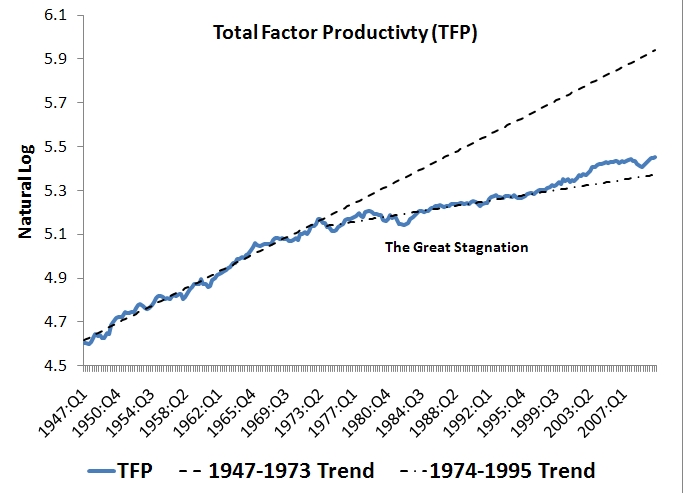
The critical responses to The Great Stagnation prefer to attack median income measures and in general they are reluctant to talk about total factor productivity. Yet we are pointed very much toward the same conclusion.
Okay, I am impressed and far less skeptical of the Great Stagnation theory. In my previous post I argued that Cowen failed to appreciate how dramatically our lives have changed since the advent of the internet and faster computing. Now I am thinking these gains are but a faint shadow of what they could have been had TFP continued to grow at its 1947-1973 trend. The "good old days" really were better in terms of TFP growth.
Still, I wonder how much of the true, underlying TFP gains are being measured given the large share of our economy that is in the service sector, where output and productivity are hard to measure. Also, I am optimistic that we are on the cusp of a Great Acceleration for the global economy. Technological gains continue and the rest of the world's catch up growth is bound to create positive spillover effects for the advanced economies. As I mentioned before, imagine what will happen to R&D funding on cancer and AIDS once several billion Asians are rich enough to start demanding it. (In fact, they may be a big part of the solution to U.S. health care problems.) This HSBC report also makes the case for an impending Great Acceleration. I am optimistic about the future.
Tuesday, February 8, 2011
CTU's Jack Bauer on the Great Stagnation Hypothesis
Tuesday, January 11, 2011
Could a Spike in the Demand for Honey Buns Cause a Recession?
Tuesday, December 7, 2010
Student Managed Investment Fund
Wednesday, September 8, 2010
What a Mess
Can the US economy really return to “business as usual” when it has 4 million houses surplus to requirement, when 1 out of 4 mortgages are in negative equity, and when by our calculation, it is burdened with $4 trillion of excess mortgage debt, equivalent to 30% of GDP?
For many years, total mortgage debt consistently and reliably equalled 0.4 times the value of the US housing stock. Intuitively, this average of 0.4 makes perfect sense as every property usually has a mortgage ranging from 0 to 0.9 times its value. So in 1990, $6 trillion of housing collateral could support $2.5 trillion of mortgages, and by 2006, $23 trillion of housing collateral could support $10 trillion of mortgages. But since then, the US housing stock’s value has slumped to $16 trillion which means the amount of mortgage lending supportable by the collateral has plunged to $6 trillion. However, actual mortgage debt has remained at $10 trillion – $4 trillion too high.
The fact that mortgage debt has barely declined suggests that relatively few homeowners have defaulted on their mortgages or paid off debt yet. Instead, a quarter of all borrowers are sitting on negative equity. That’s just as well – because were mortgage debt to shrink by even half of $4 trillion, the US economy would slump.

I was reminded of Joshi's article after reading this by Tyler Cowen:
It seems increasingly clear that we must [let house prices fall]. For how long can the government prop them up? Are we never to have a private market in mortgages again?
Yet what happens if we let them fall? Arguably many banks would once again be "under water." Enthusiasm for another set of bailouts is weak, to say the least. Our government would end up nationalizing these banks and it still would be on the hook for their debts. The blow to confidence would be a major one, especially if along the way we saw a recreation of a Lehman or Bear Stearns or A.I.G. episode.
I increasingly believe there is no easy way out of this dilemma and it is a major reason why the U.S. economy remains stuck. Housing prices must fall, yet...housing prices must not fall.
Gouge Away
They [the folks who believe a price increase is okay] know enough to know that if there is a demand shift, not only is it OK to raise prices, but you should raise prices in order to clear the market. In this case, supply is fixed in the short term, so raising the price won’t increase supply; the Econ 101 argument is that raising the price allocates the shovels to people who will derive more utility from them (because they will pay more), thereby increasing social welfare.Of course, he quickly dismisses this line of reasoning:
But this rests on a huge assumption: that willingness to pay is the same as utility. Unfortunately, however, this assumption fails in the real world; poor people simply can’t pay as much for snow shovels as rich people, and as a result a price increase will allocate shovels to rich people, not to those who need them the most.
The analysis is grossly inadequate here. First, the supply may be fixed in the short run, but by allowing prices to rise there will be eventually an increase in supply. For example, a town hit by a hurricane does have a fixed supply of generators. If prices are allowed to rise then at some point they get high enough to induce suppliers from outside the city to start bringing additional generators to the devastated area. If there is no price increase they have no incentive to send their extra generators. Likewise, good old boys from out of town may decide it is worth their while to throw some chainsaws and other tools in the back of their pickups and head down to disaster-hit town if they think they can earn higher fees. If price gouging laws are put into place these good old boys stay at home and the recovery takes longer. In short, by allowing higher prices there is a dynamic effect on supply that ultimately improves human welfare.
Second, the critique that willingness to pay is not the same as utility similarly misses some important points. It ignores that the “rich” people may be banks, grocery stores, and hospitals–the very entities we want scarce resources like generators going to in a crisis so that we can get money, food, and healthcare. It also ignores the fact if resources aren’t allocated by price they will be allocated by other means that will not seem anymore fair. For example, owners of hardware stores might allocate by first come, first serve or by who they know. One can easily imagine the “rich” getting to the hardware store first or the connected getting the goods because they know the owner. The big point here is that Kwak's analysis offers up no meaningful alternative allocation method and that is because there is none.
Friday, July 23, 2010
Wednesday, July 14, 2010
Monday, May 10, 2010
Monday, April 19, 2010
Where is the U.S. Currency?
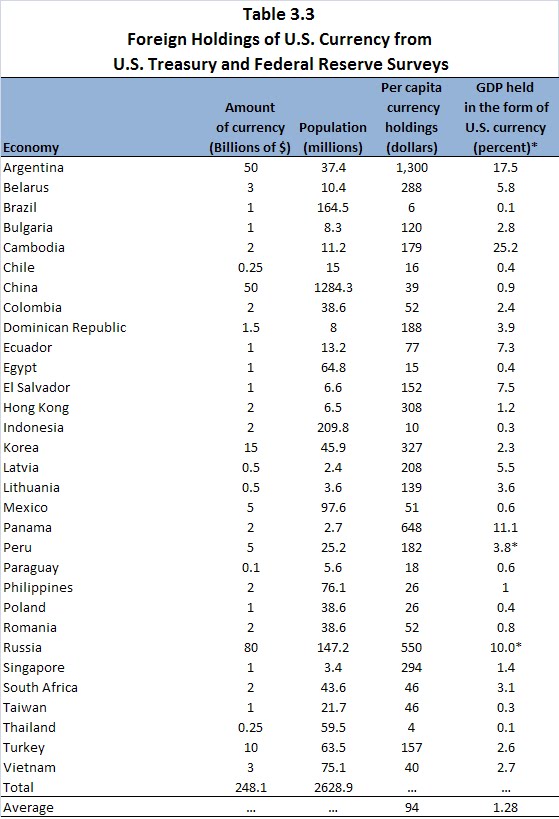
So which countries in the world have been so generous to the United States? Here is a table from the Treasury report that accounts by country for about $250 billion of the total U.S. currency notes held abroad (click on figure to enlarge):

Unsurprisingly, most of the currency is being held by emerging and developing economies. Presumably all of these countries at some point in the past had some form of monetary instability and, as a result, their residents are now demanding a relatively safe alternative form of money, the dollar. So what denominations are these folks holding? Linda Goldberg has put together a nice chart that answers this question:
It is interesting to see the increasing demand for $100 bills and the decreasing demand for $50 and $20 bills. Maybe the dollars are being held more as a store of value than a medium of exchange and, thus, the larger bills are more in demand.Sunday, April 11, 2010
Interest Payment on Excess Reserves Smackdown
The Federal Reserve has recently activated its newly acquired powers to pay interest on reserves of depository institutions. The Fed maintains its new policy increases economic efficiency and intends it to play a lead role in the exit from quantitative easing. This paper argues it is a bad policy that (1) has a deflationary bias; (2) is costly to taxpayers and that cost will increase as normal conditions return; and (3) establishes institutional lock-in that obstructs desirable changes to regulatory policy. The paper recommends repealing the Fed’s power to pay interest on bank reserves. Second, the Fed should repeal regulation Q that prohibits payment of interest on demand deposits. Third, the Fed should immediately implement an alternative system of asset based reserve requirements (liquidity ratios) that will improve monetary control and can help exit quantitative easing at no cost to the public purse. Now is the optimal time for this change. Lastly, the paper argues the new policy of paying interest on reserves reveals the troubling political economy governing the actions of the Federal Reserve and policy recommendations of the economics profession.Read the rest here.
Tuesday, March 30, 2010
And I Thought New Zealanders Were Tough on Their Central Bankers
If media reports in South Korea are accurate, earlier this month, North Korea hauled its equivalent ofAlan Greenspan[, Pak Nam Gi,] in front of a firing squad.
[...]Many analysts believe Pak was made a scapegoat for the currency reform.
So what went wrong? It seems that the currency "reform" was more of a currency debasing:
The currency reforms were meant to confiscate merchants' wealth and give it to farmers, workers and soldiers in the state sector. Many state-owned firms have fallen idle, and their workers have gradually migrated to the free markets to survive.
The plan worked, at least for a while, says Kim Yun-tae, secretary general of the Network for North Korean Democracy and Human Rights, a Seoul-based group that gets information from a network of informants in North Korea.
"The government printed money and distributed it to farmers and the lower classes," Kim says. "People loved it at first. But when the working class spent all that money, it was eaten up by inflation, and their lives got even harder."
Another needless tragedy for North Korea and another needless disruption to the welfare of North Koreans.
Friday, February 26, 2010
Further Evidence that the Future Belongs to Statisticians
EIGHTEEN months ago,This is why Hal Varian is right when he says the sexy job in the next decade will be a statistician.Li & Fung , a firm that manages supply chains for retailers, saw 100 gigabytes of information flow through its network each day. Now the amount has increased tenfold. During 2009, American drone aircraft flying over Iraq andAfghanistan sent back around 24 years’ worth of video footage. New models being deployed this year will produce ten times as many data streams as their predecessors, and those in 2011 will produce 30 times as many. Everywhere you look, the quantity of information in the world is soaring. According to one estimate, mankind created 150 exabytes (billion gigabytes) of data in 2005. This year, it will create 1,200 exabytes. Merely keeping up with this flood, and storing the bits that might be useful, is difficult enough. Analysing it, to spot patterns and extract useful information, is harder still.
Friday, February 5, 2010
Ben Bernanke and the Super Bowl
Monday, January 25, 2010
The Keynes and Hayek Rap
Update I : On a related note here is an interesting paper titled "Hayek versus Keynes on How the Price Level Ought to Behave" (gated) by George Selgin.
Update II: On another related note, William White says the future of macroeconomics should be shaped by a synthesis of Keynesian economics, Austrian economics, and Minskian economics. I think such a synthesis would point to monetary policy that (1) targeted nominal spending and (2) implemented a robust macroprudential framework. See here for more of White's insights leading up to the crisis.
Thursday, January 14, 2010
The Stand-Up Economist
Monday, December 14, 2009
Taking the Long View
Monday, December 7, 2009
A 100 Trillion Dollar Zimbabwe Bill
Yes, this a 100 trillion dollar note with fourteen zeros. Note that the bill apparently has several anti-counterfeiting measures like the golden bird statue on the right front. That is surprising; surely the opportunity cost of counterfeiting this bill far exceeded any benefit. Just how worthless is this currency now? Below is a picture that answers this question succinctly (click on picture to enlarge):