Pages

Monday, October 11, 2010

Bretton Woods 2 vs. QE 2: Smackdown of the Decade?

My thinking on QE 2 has always been from a cyclical perspective. Thus, in my view calls for the Fed to do more to shore up aggregate spending and stabilize nominal expectations occur because these things had fallen off their long-term trend during the past recession.  I had not been envisioning QE 2 as ushering in a structural shift in the U.S. economy, let alone the global economy.  But according to both Ambrose Evans-Pritchard and Tim Duy I may be missing something here.  These two observers are making the case that QE 2 will turn out to be nothing less than a crude but effective assault on the Bretton Woods 2 system.  Here is Evans-Pritchard:
Asian investment in plant has run ahead of Western ability to consume. The debt-strapped households of Middle America, or Britain and Spain, can no longer hold up the dysfunctional edifice. Asians must take over, or it will come down on their own heads.

The countries actively intervening in exchange markets to suppress their currencies – China, Japan, Korea, Thailand, even Switzerland, to name a few – are all too often the same ones that have the biggest trade surpluses with the US...

Yet this is an intolerable situation for the US. It should be no surprise that Washington has begun to retaliate in earnest...The atomic bomb, of course, is quantitative easing by the Federal Reserve. America has in effect issued an ultimatum to China and G20: either you stop this predatory behaviour and agree to some formula for global rebalancing, or we will deploy QE2 `a l’outrance’ to flood your economies with excess liquidity. We will cause you to overheat and drive up your wage costs. We will impose a de facto currency revaluation by more brutal and disruptive means, and there is little you can do to stop it. Pick your poison. 
Wow, QE 2 will be the atomic bomb that ends Bretton Woods 2.  Evans-Pritchard has always had a way with words. Tim Duy agrees and is concerned that international tensions could escalate:
The time may finally be at hand when the imbalances created by Bretton Woods 2 now tear the system asunder. The collapse is coming via an unexpected channel; rather than originating from abroad, the shock that sets it in motion comes from the inside, a blast of stimulus from the US Federal Reserve. And at the moment, the collapse looks likely to turn disorderly quickly. If the Federal Reserve is committed to quantitative easing, there is no way for the rest of the world to stop to flow of dollars that is already emanating from the US. Yet much of the world does not want to accept the inevitable, and there appears to be no agreement on what comes next. Call me pessimistic, but right now I don't see how this situation gets anything but more ugly.
Note that this line of thinking recognizes the Fed as a monetary hegemon.  Its monetary policy get exported to the much of the world and thus, QE 2 will get exported as well.  Consequently, many countries will have to either (1) let their currency appreciate against the dollar and lose some external competitiveness or (2) intervene in foreign exchange markets to prevent this appreciation from happening.  The latter option, however, comes at the cost of an increase in their own money supply that will, as Evans-Pritchard notes, lead to a massive stimulus in their own economy. (They could sterilize this increase in the money supply, but it too  creates a quasi-fiscal cost.) Might this latter development become too much to bare and lead to the break-up of the Bretton Woods 2 system? Maybe, but given the scope and reach of  the U.S. dollar as a reserve currency this would be quite the feat.

Friday, October 8, 2010

What Do John Cochrane and Milton Friedman Have In Common?

Yes, they are both well-known economists from the University of Chicago, but there is more.   Milton Friedman in the early 1990s called for the Federal Reserve to start targeting the expected inflation rate implied by the difference between the nominal treasury yield and the real TIPs yield.  He made this call in his book Monetary Mishief.* Now John Cochrane is advocating this approach too:
[T]he Fed can target the thing it cares about – expected CPI inflation – rather than the price of gold.  To do it, the Fed can target the spread between TIPS (Treasury Inflation Protected Securities) and regular Treasurys, or CPI futures prices.  Here’s a simple example. Investors buy a CPI-linked security from the Fed for $10.  If inflation comes out to the Fed’s target, they get their money back with interest,  $10.10 at 1% interest. If inflation is 2 percent below target, the Fed pays $2 extra -- $12.10.  This pumps new money into the economy, with no offsetting decline in government debt, just like the helicopter drop. If inflation is 2 percent above target, investors only get back $8.10 – the Fed sucks $2 out of the economy at the end of the year.  If investors think inflation will be below the Fed’s target, they buy a lot of these securities, and the Fed will print up a lot of money, and vice versa.
I am thrilled to see a prominent economist like John Cochrane promoting this forward-looking approach to monetary policy. Had the Fed had such a target in place in 2008 it would have seen a drop in inflationary expectations well before Lehman's crash.  But it did not and, as result, it sat passively by and allowed an effective tightening of monetary policy during 2008. 

Of course, I would like the Fed to do one better and adopt a forward-looking NGDP target.  A foward-looking NGDP target would be more effective because the NGDP target focuses on that which the Fed has influence: nominal spending.  A forward looking inflation target may at times lead the Fed to respond to more than just nominal spending shocks.  This is because movements in inflation can reflect both aggregate demand and aggregate supply shocks. Macroeconomic stability requires the Fed only respond to former and ignore the latter.  With that said, I am happy to see John Cochrane pushing this debate in the right direction.  


(Hat Tip: Scott Sumner)

*The idea for targeting the expected inflation rate implied by TIPs originated with Robert Hetzel.  Interestingly, he too is a product of the University of Chicago.

Thursday, October 7, 2010

Is This Really It?

I want to believe but will wait for further confirmation that the uptick in expected inflation--a proxy for  expected aggregate demand--is truly a change from the downward trend of January-September 2010.  For now, though, it does seems all the chatter coming from William Dudley, Brian Sack, Eric Rosengreen, Charles Evans, and other Fed officials on QE2 is doing a great job in changing inflation expectations.  Here is the expected inflation rate on the five-year treasury up through October 5 (Click on figure to enlarge.):


I was planning on waiting for further confirmation before commenting on this apparent shift in inflation expectations, but decided to go ahead and note it given its recognition by Paul Krugman. So here are my thoughts:

(1) This upward movement in expected inflation means the Fed has already begun a passive easing of monetary policy well before the actual QE2 has been implemented. Because future economic activity influences present economic activity, the Fed is already influencing current aggregate spending by altering expectations.   

(2)  There is still an overall downward trend for 2010.  This downward trend means the Fed allowed passive monetary tightening for most of the year and it now is being reversed.   There is a lot  of ground to made up.    

(3) Nothing guarantees that this uptick has permanently changed the downward trend for 2010. As can be seen in the figure above, expectations started to recover in April by a similar amount but subsequently fell as the Eurozone mess intensified and drove up the demand for liquidity.  Something similar could happen this time too as there are still plenty of problems lurking in the global economy.  Moreover, we may get to the November FOMC meeting and find the actual QE2 may be much less than the market expected. Not everyone on the FOMC is supportive of QE2. This too would push expectations back down and led to more passive tightening of monetary policy.

(3) Right now the change in expectations is based on the chatter coming from Fed officials.  This requires carefully examining their words and determining how much influence each Fed official has on the FOMC.  How much better it would be if the Fed followed Milton Friedman's suggestion outlined in his book Money Mischief and set an explicit target for the expected inflation rate. This would add more certainty than currently comes form diving the words of Fed officials. I actually would prefer--and believe Friedman would endorse it--for the Fed to target expected NGDP.  But for reasons outlined by Karl Smith, I would settle for an explicit expected inflation target at this point.

So is this really it? Has the Fed finally decided to get serious about stabilizing nominal spending?  I hope so.

Update: Dallas Fed President Richard Fisher in a speech today suggests that the market might be ahead of itself in assuming that QE2 is done deal (my bold):
I am afraid that despite recent speculation in the press and among market pundits, we did little at that meeting to settle the debate as to whether the Committee might actually engage in further monetary accommodation, or what has become known in the parlance of Wall Street as “QE2,” a second round of quantitative easing. It would be marked by an expansion of our balance sheet beyond its current footings of $2.3 trillion through the purchase of additional Treasuries or other securities. To be sure, some in the marketplace―including those with the most to gain financially―read the tea leaves of the statement as indicating a bias toward further asset purchases, executed either in small increments or in a “shock-and-awe” format entailing large buy-ins, leaving open only the question of when.
[...]
There is a great deal of legitimate debate still to take place within the FOMC on the subject of quantitative easing and the pros and cons and costs and benefits of further monetary accommodation. Whatever we might do, if anything, must be consistent with long-term price stability and not add to the nightmare of confusing signals already being sent to job creators.

Wednesday, October 6, 2010

The Quasi-Monetarist

Scott Sumner summarizes the key tenets of those who observers, including myself, who have been labeled as quasi monetarists by Paul Krugman :
1.  Like the monetarists, we tend to analyze AD shocks through the perspective of shifts in the supply and demand for money, rather than the components of expenditure (C+I+G+NX).  And we view nominal rates as an unreliable indicator of the stance of monetary policy.  We are also skeptical of the view that monetary policy becomes ineffective at near-zero rates.
2.  Unlike monetarists, we don’t tend to assume the demand for money is stable, and are skeptical of money supply targeting rules.
As I noted before, quasi-monetarists are not that different from other folks who see an AD problem in the economy.  One defining difference, though, is that quasi-monetarists see the insufficient AD issue ultimately as an excess-money demand problem and believe the Fed could meaningfully address it.   Another defining difference is that quasi-monetarists were calling for more Fed action long before it was vogue.  Thus, early on in the recession when other folks were calling for fiscal policy to address the AD problem, quasi-monetarists were instead calling for the Fed to step up and address the fall in nominal spending. 

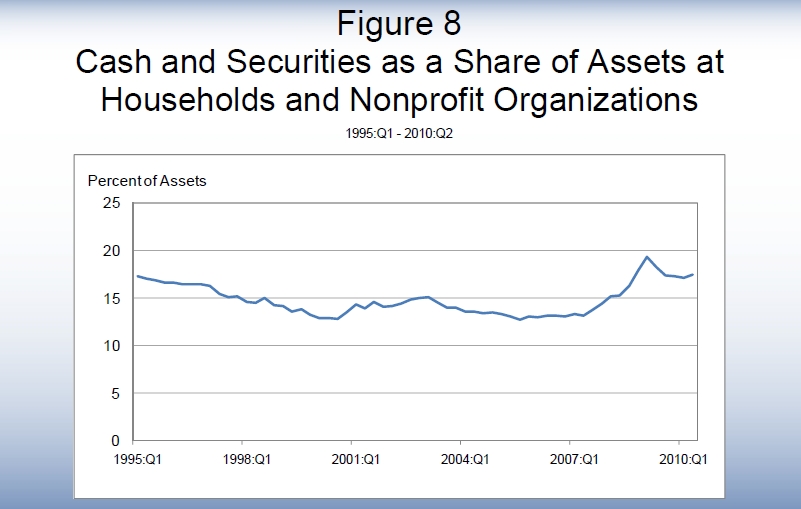
Does the quasi-monetarist's emphasis on excess money demand have any merit? Is there any evidence that the AD problem is ultimately an excess money demand problem?  Drawing on Gary Gorton's work that shows repos are a form of money--an understanding supported by the fact the now discontinued M3 money supply  included repos--for the shadow banking system, the blogger 123 presents evidence from a natural experiment around the time of the Lehman collapse that  shows there was a sudden spike in the demand for money.  Below are charts that present further evidence that there has been an elevated increase in the holdings of cash and other highly liquid (i.e. cash equivalent) securities by households, businesses, and banks.  These charts come from Eric Rosengren's recent speech:  (Click on figures to enlarge.)


Though Eric Rosengren does not call himself a quasi-monetarist, his speech is consistent with this view: it argues there is a AD problem, it shows the above graphs that indicate an elevated increase in money demand, and it calls for more aggressive Fed action to address these problems. Rosengren's implicit endorsement of the quasi-monetarist's view is probably not unique.  I suspect most folks who see the need for more Fed action would, after some reflection on the excess money demand take on the AD problem, consider themselves a quasi-monetarist.  Are you?

More Evidence That There is a Serious AD Problem

Eric Rosengren, President of the Federal Reserve Bank of Boston,  recently delivered a speech  where he presented further evidence that the problems in the labor market are more the result of weak aggregate demand than structural factors:
[I]n each of the three previous recessions there was a decline [in employment] of 5 percent or more in no more than two industry categories – as the figure shows – with many industries experiencing little or no net job loss over the course of the recession. Structural hifts acrossindustries are not uncommon in recessions – and also, some structural dislocation seems inevitable as it will always take some time for capital and labor to flow to those industries with the greatest opportunities.

In rather stark contrast, the most recent recession is far less a reflection of dislocation in a few industries but rather reflects a general decline in almost all industries. As the chart  [below] shows, in this recession there has been a peak to trough loss of employment of 5 percent or greater in construction, manufacturing, retail trade, wholesale trade, transportation, information technology, financial activities, and professional and business services. To me, this does not suggest that the driver is structural change in the economy increasing job mismatches – although no doubt some of that exists – but instead I see here a widespread decline in demand across most industries.
Here is the accompanying figure from his speech (Click on figure to enlarge):


With this evidence from the labor markets in mind take a look at this figure on final sales of domestic product, a measure of aggregate demand: (Click on figure to enlarge.)


This figure shows that the growth rate of AD remains low and by implication the level of AD is also well below trend. After examining these graphs it is hard not to think insufficient aggregate spending is a serious problem now facing the economy.  Yes, there are structural problems but they are only being made worse by the lack of appropriate monetary policy actions to stabilize AD. 

Tuesday, October 5, 2010

More on TARP

As a follow-up to my previous post on TARP, here are some more commentaries on the end of this proram. A key point these pieces make is that while TARP saved the financial system it did so at the cost of significantly increasing moral hazard and thus planted the seeds of the next financial crisis:

(1) Count on Sequels to TARP--Gretchen Morgenson

(2) Going Viral: Why TARP, Like Herpes, is a "Gift" that Keeps on Giving--Alain Sherter

(3) The End of TARP: Goodbye and Good Riddance--Henry Blodget and Aaron Task

Friday, October 1, 2010

We Are All Quasi-Monetarists

Paul Krugman weighs in on the debate stirred up by my post on the excess demand for money:
Brad DeLong manfully takes on the efforts of various commentators to define away the paradox of thrift and redefine our current problems as somehow wholly monetary. As I see it, this is all a desperate attempt to cut and stretch things into a quasi-monetarist framework, for no good reason. 
So those of us who believe that all along the Fed could have done more, should have done more, and still should be doing more are now "quasi-monetarists." Fine, but addressing the above list of  Fed shortcomings was the  ultimate point of  my post.   Yes, I did this by pointing out that the current aggregate demand problem is at its core an excess money demand problem.  And, thus, policymakers who wish to address the AD problem must ultimately address an excess money demand problem.  Here, I was just attempting to take a deeper look at the AD problem from a monetary perspective.  DeLong really didn't disagree with my assessment, he just questioned how the Fed could address the excess money demand problem in practice.   The fact is we really aren't all that different on this issue.  Even Krugman at some level is a quasi-monetarist--he has to be given we live in monetary economy.  This point is forcefully made by both Nick Rowe and Scott Sumner in their replies to Krugman.

Update: Josh Hendrickson adds further perspective on this debate.