Pages

Tuesday, July 13, 2010

It's Gone Global

Rebecca Wilder alerts us to the fact that the drop in inflation expectations is not limited to the United States:
[I]nflation expectations are falling globally. The chart [below] illustrates the 10-yr break-even expected inflation rates for the UK, Germany, Canada, Italy, and the US using their respective inflation-indexed bond markets (TIPS in the US). Notably, declining inflation expectations is not specific to the US.
Here is her chart:


What this chart says to me is that not only is the Fed allowing U.S. aggregate demand to slip, but it is also allowing global aggregate demand to falter. How so? It all goes back to the Fed's role as a monetary hegemon. As I noted earlier:
[T]he Fed is a global monetary hegemon. It holds the world's main reserve currency and many emerging markets are formally or informally pegged to dollar. Thus, its monetary policy is exported across the globe. This means that the other two monetary powers, the ECB and Japan, are mindful of U.S. monetary policy lest their currencies becomes too expensive relative to the dollar and all the other currencies pegged to the dollar. As as result, the Fed's monetary policy gets exported to some degree to Japan and the Euro area as well.
The Fed's monetary hegemon status in conjunction with its loose monetary policy during the early-to-mid 2000s helped create the global liquidity glut at that time. As a consequence, there was an unsustainable boom in global aggregate demand. Now the Fed's superpower status is working in the opposite direction: it is allowing to global demand to slow down. Focus, Ben, Focus!

Monday, July 12, 2010

Daniel Gross on the Types of Deflation

Amidst all the chatter about deflation, Daniel Gross over at Newsweek reminds us that deflation can emerge for two very different reasons: (1) a collapse in aggregate demand or (2) a surge in aggregate supply. This distinction is an important one that is often overlooked when it comes to conduct of monetary policy. Before getting into the policy implications, though, let's look at how these two forms of deflation are different. Here is how Gross describes deflation coming from a collapse in aggregate demand:
Bad deflation is the kind we had in the Great Depression. "The last time we really had significant deflation in the U.S. was in the 1930s," notes Michael Bordo, professor of economics at Rutgers University. "Between 1929 and 1933, prices fell on average by 15 percent." This deflation was driven by a decline in output, demand, and credit—too little money and wages chasing too many goods and workers. The Depression-era cratering of wages and prices was disastrous because it rendered companies and consumers less able to pay their debts.
There is no question this is type of deflationary pressures we experienced during the first half of 2009 and now face again in late 2010. The key to preventing such deflation is to stabilize aggregate demand via monetary policy. Lately, it appears the Fed has been failing to do just this.

The second type of deflation is the result of positive aggregate supply shocks. Here is how Gross explains this form:
But there have been periods of good deflation, in which prices fell even as the economy boomed. In the 1920s, known to this day as the roaring '20s because of the decade's economic vibrancy, prices fell about 1 percent per year. Between 1870 and 1896, prices fell consistently amid rapid economic growth—with plenty of booms and busts along the way. The reason: innovations like the railroad, the telegraph, electricity, and the assembly line helped farmers, entrepreneurs, and manufacturers to produce and ship their goods more cheaply and efficiently.
As mentioned above, the distinction between these two forms of deflation is important when it comes to policy implications. The harmful form of deflation requires aggressive monetary easing to stabilize aggregate demand while the benign form does not. In fact, the benign form of deflation if driven by rapid productivity growth would imply, cetersis paribus, a higher neutral interest rate. Lowering the policy interest rate here would push market interest rates below the neutral rate, lead to excessive monetary easing, and too much current dollar spending. So no need for monetary or aggregate demand stimulus here. In short, both forms of deflation call for stabilizing aggregate demand.

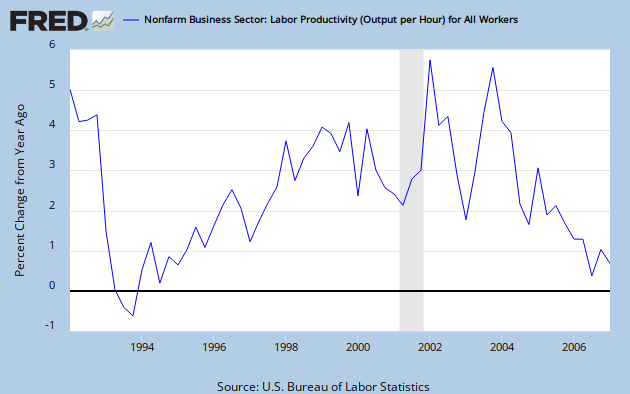
I bring these differences up because it seems clear to me that one of key reason we are this mess now is that the Fed in the early-to-mid 2000s failed to make this distinction. It saw the deflationary pressures of that time as indicating the harmful, demand-induced form when in fact they were the result of the rapid productivity gains at that time. Here is one graph the makes my point:

This figure shows that the growth rate of domestic demand started accelerating in mid-2002 and continued increasing through late 2004. There were no signs of collapsing demand here. Yet the Fed still saw a threat of demand-induced deflation at least through late 2003. As a result, the Fed continued to push the federal funds rate lower and held it low until mid-2004. What the Fed ignored was that the productivity gains at the time were pushing down the inflation rate. The rest is history. (The Fed also got hung up on the negative output gap. But like the deflationary pressures, much of this gap was being driven the rapid productivity gains not a collapse in demand.)

Now in real time it may be hard to distinguish between aggregate demand-induced deflation and aggregate supply-induced deflation. For example, since the U.S. economy had just come out of the 2001 recession it is understandable why the Fed misread the deflationary tea leaves over 2002-2003. Fortunately, there is a way that makes it possible for monetary authorities to avoid making such mistakes: target aggregate demand or some measure of total spending. Stabilize this and the deflation distinction becomes a moot issue.

Read here for more on this issue.

Jim Hamilton's Sobering Thought

A sobering thought from Jim Hamilton:
So I can see who bought the $2.7 trillion in net new Treasury debt issued between 2007 and 2009. What I'm having more trouble seeing is who is going to buy the additional $8 trillion in net new debt that would be issued over the next decade under the CBO's alternative fiscal scenario.
Hamilton notes that over half of the new debt between 2007 and 2009 went to foreigners. Can the rest of the world continue to absorb this large of a share of the projected $8 trillion shortfall? The only way I see this happening is that the rest of the world has rapid economic growth over the next decade and during this time there is no alternative treasury or other safe asset market that emerges to compete with the U.S. treasury market. What do you think?

Krugman is Finally Beating the Right Drum

After year or so of beating his fiscal stimulus drum, Paul Krugman is finally starting to pound on his monetary policy drum. It is about time. There is reason to believe that had influential observers like Krugman been making the case sooner for unconventional monetary policy that aims to shape expectations--versus Ben Bernanke's narrow focus on "credit easing"--we would not be currently discussing the imminent threat of deflation. As I mentioned in my previous post, the one time unconventionally monetary policy was truly tried it was very effective. Krugman himself admitted last year that the first-best option for a situation like ours today is not fiscal policy but unconventional monetary policy:
The first-best answer — that is, the answer that economic models, like my old Japan’s trap

analysis, suggest would be optimal — would be to credibly commit to higher inflation, so as to reduce real interest rates.

But the key thing to recognize about this answer is that it’s all about expectations — the central bank only has traction over expected inflation to the extent that it can convince people that it will deliver that inflation after the liquidity trap is over. So to make this policy work you have to (i) convince current policymakers that it’s the right answer (ii) Make that argument persuasive enough that it will guide the actions of future policymakers (iii) Convince investors, consumers, and firms that you have in fact achieved (i) and (ii)

So why has Krugman been pushing expansionary fiscal policy so heavily up til now? Here is his answer:

So some readers have asked why I’m not making the same arguments for America now that I was making for Japan a decade ago. The answer is that I don’t think I’ll get anywhere, at least not until or unless the slump goes on for a long time. OK, so what’s next? The second-best answer would be a really big fiscal expansion, sufficient to mostly close the output gap.

In short, Krugman settled for a second-best economic solution because he thought it was a first-best political solution. So much for that strategy. I should not complain too much, though. He seems to be getting on board now and for that I am grateful. Here he is making the case for unconventional monetary policy in his latest column:
But here we are, visibly sliding toward deflation — and the Fed is standing pat.

What should it be doing? Conventional monetary policy, in which the Fed drives down short-term interest rates by buying short-term U.S. government debt, has reached its limit: those short-term rates are already near zero, and can’t go significantly lower. (Investors won’t buy bonds that yield negative interest, since they can always hoard cash instead.) But the message of Mr. Bernanke’s 2002 speech was that there are other things the Fed can do. It can buy longer-term government debt. It can buy private-sector debt. It can try to move expectations by announcing that it will keep short-term rates low for a long time. It can raise its long-run inflation target, to help convince the private sector that borrowing is a good idea and hoarding cash a mistake.

Keep beating that drum Krugman.

Friday, July 9, 2010

What Can the Fed Do Now?

A lot, actually. We know this because (1) Fed officials believe there is much more they could do if they wanted and (2) monetary policy has been shown to be highly effective in far worse situations. The problem is the Fed has been reluctant to act so far. It has failed to pull out all of its big guns though there are some rumblings it may be considering doing so.

So what exactly are the big guns the Fed could employ in our current situation? According to these Fed economists there are three big guns that could be used:
(1) [S]haping the expectations of the public about future settings of the policy rate, (2) increasing the size of the central bank’s balance sheet beyond the level needed to set the short-term policy rate at zero (“quantitative easing”); and (3) shifting the composition of the central bank’s balance sheet in order to affect the relative supplies of securities held by the public.
The first big gun is in my view the most important one and can be restated as shaping expectations in general, not just expectations about the policy interest rate. Here the main idea is to convince the public that Fed is committed to a higher inflation rate or price level for the foreseeable future. This would lower current real interest rates, decrease the demand for money (i.e. increase velocity), and help stabilize (and maybe even restore) household and other troubled balance sheets. Currently, however, this big gun is just sitting in the Fed's arsenal collecting dust. The other two big guns, as is well known, have been used as seen by the enlargement and asset alteration of the Fed's balance sheet. While these big guns have been effective in stemming the credit crisis they have been less effective in stabilizing velocity. What has been frustrating about the Fed's choice of the big guns to use so far is that there is reason to believe the first big gun by itself would have accomplished as much or more than what the second two big guns have done. This first big gun was used during the Great Depression by FDR with much success and suggests it should have been tried already by the Fed. Here are those same Fed economists on this experience:
An historical episode that may illustrate this channel at work (although the policymaker in question was the executive rather than the central bank) was the period following Franklin Roosevelt’s inauguration as U.S. president in 1933. During 1933 and 1934, the extreme deflation seen earlier in the decade suddenly reversed, stock prices jumped, and the economy grew rapidly. Romer (1992) has argued persuasively that this surprisingly sharp recovery was closely associated with rapid growth in the money supply that arose from Roosevelt’s devaluation of the dollar, capital inflows from an increasingly unstable Europe, and other factors... Temin and Wigmore (1990) [argue] that the key to the sudden reversal was the public’s acceptance of the idea that Roosevelt’s policies constituted a “regime change.” Unlike the policymakers who preceded him showing little inclination to resist deflation and, indeed, seeming to prefer deflation to even a small probability of future inflation, Roosevelt demonstrated clearly through his actions that he was committed to ending deflation and “reflating” the economy. Although the president could have simply announced his desire to raise prices, his adoption of policies that his predecessors would have considered reckless provided a powerful signal to the public that the economic situation had fundamentally changed. If one accepts the Temin-Wigmore hypothesis, then it appears that the signal afforded by Roosevelt’s exchange rate and monetary policies were central to the conquest of deflation in 1933-34.
So altering expectations here required both substantive action--actual sharp increase in the monetary base--as well as a public perception of a regime change by FDR. These actions worked and according to Christina Romer were the main reason for the robust recovery of 1933-1936. This experience suggests something similar should be done by the Fed today. So how could Fed employ this first big gun now? First, the Fed needs to to introduce an explicit inflation, price level , or nominal GDP target (my preference is for the later) and say that it is committed to this target no matter what it takes. Second, it needs to accompany this move with a PR blitzkrieg that makes it very clear this is a game changer, a real regime change. Of course, all this assume that the Fed decides that it wants to make such changes. Currently it is not clear that all Fed officials would welcome such changes.

Hopefully there are some folks inside the Fed who are listening. At a minimum I hope the Fed economists cited above are listening. One of them happens to lead the Fed.

Meanwhile, Back in the Eurozone...

the legal noose tightens on Europe's monetary union according to Ambrose Evans-Pritchard:
The plot continues to thicken at Germany’s constitutional court, a body with power of life or death over Europe’s monetary union.

Contrary to general belief, Germany’s eurosceptic professors have not abandoned their legal efforts to block the EU rescues for European banks exposed to Greek debt, and since May 7 for banks exposed to debt from Spain, Portugal, and Ireland as well.

Should they succeed, of course, the eurozone risks disintegration within days, and perhaps hours. I am not sure that investors in New York, London, Tokyo, Beijing, or indeed Frankfurt quite understand this.

I certainly was not aware this German court had the Eurozone in its sights. Developments like these only serve to reinforce Kati Suominen's claim that the dethroning of the dollar as the main reserve currency will not happen anytime soon.

What is the Current Stance of Monetary Policy?

Mathew Yglesias is making the case that the current stance of monetary policy is effectively tight. He invokes the term structure of interest rates to make his case. While I share his view, I believe a far more intuitive and convincing way to make this point is to look at the difference between the nominal interest rates on regular treasury securities and the real interest rates on treasury inflation protected securities (TIPS). The difference or spread between these two series is the market's expectation of future inflation.* To the extent changes in expected inflation are being shaped by monetary policy via its influence on aggregate demand, this measure provides a real time indicator on the stance of monetary policy. This indicator is graphed below using daily data on 5-year treasuries for the period January 4, 2010 - July 8, 2010: (Click on figure to enlarge.)

There is a clear downward trend. Now changes in expected inflation can come from both aggregate supply (AS) shocks and aggregate demand (AD) shocks. But given the Eurozone uncertainty, weak economic data, and all the austerity talk of late, the most obvious way to interpret this declining trend is that the market expects aggregate demand to weaken. This interpretation is also consistent with all the chatter about deflation noted by Mark Thoma. And since monetary policy has been doing nothing to stop this implied plunge in AD it is effectively tightening.

Now it is possible that an increase in the liquidity premium coming from the heightened uncertainty is driving some of this decline, but even if true it only serves to strengthen my interpretation. For in that case their is an increased demand for liquid assets of which money is the most liquid. Money demand, therefore, would be rising and velocity falling. So no matter what path you follow you end finding weakening AD and an effective tightening of monetary policy.

*This is because of the fisher equation that says nominal interest rates = real interest rates + expected inflation.